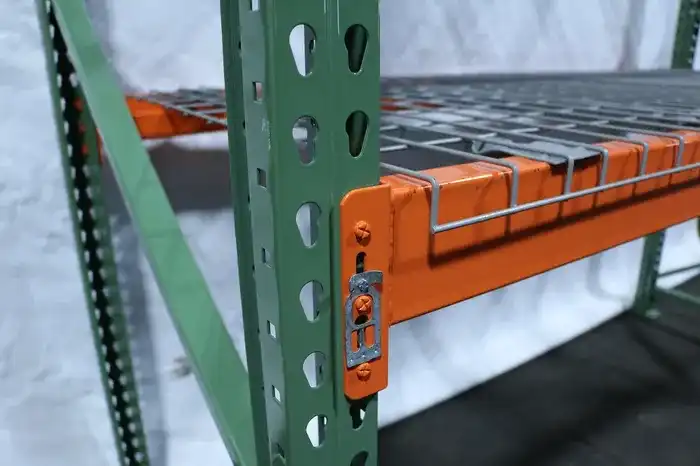


Traditional warehousing systems often face challenges such as insufficient space utilization, inefficient inventory management, and limited operational flexibility, leading to reduced logistics efficiency and increased operating costs. Push Back Racking utilizes gravity flow to achieve last-in, first-out access for goods, significantly improving storage density and warehousing efficiency.
This system optimizes warehouse layout, Push-back racking is also designed for first-in, last-out (FILO) inventory management. This effectively alleviates the conflict between inventory management and space utilization, improving the continuity and safety of overall warehousing operations.
In this blog post, we take an in-depth look at push back racks and explore how they can optimize your warehouse space.
What is Push-Back Racking?
Push-back racking is a dynamic storage system commonly used for pallet storage in warehouses.
In this system, pallets are loaded onto wheeled platforms that rest on inclined rails. When a new pallet is placed into the lane, it pushes the previously stored pallets further back.
Retrieval always takes the pallet at the front of the lane, first-in, last-out (FILO) system. This design maximizes storage density and is especially useful for items that are stored in similar quantities or have a similar turnover rate.

Types of Push-Back Racking
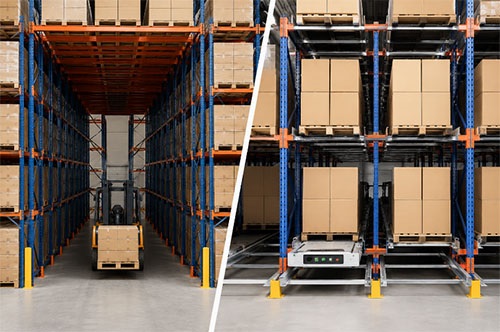
There are two main variations of push-back racking: push-back with carts (also known as shuttles) and push-back with rollers.
- push-back with carts: involves placing each pallet on a shuttle that glides along dedicated rails.
- push-back with rollers: employs fixed beds attached to the structure, designed with a slight incline.
Each system provides a highly efficient method for storing and managing inventory within your warehouse or distribution center.
How Push-Back Rack Works
A Push-Back Rack is a type of pallet storage system that uses gravity and inclined rails to store multiple pallets in a single lane. Here’s how it works:

1. Structure and Inclination
- The rack is designed with a series of nested carts or shelves that run on rails set at a slight downward angle (usually around 2–3°).
- This incline is critical because it allows the pallets to roll or slide forward by gravity.
2. Loading Process
- A new pallet is loaded from the back of the lane.
- Once placed, the new pallet pushes the previously stored pallet slightly forward along the rail system.
- This stacking method creates a “push-back” effect where each new pallet automatically positions itself at the rear, ensuring the front remains accessible.
3. Retrieval Process
- When a pallet at the front of the lane is needed, it is removed first (first-in, last-out or FILO).
- After removal, the inclined design enables the next pallet to roll forward and take its place, ready for retrieval.
- This minimizes manual handling and helps maintain an organized flow of goods.
Advantages of Push-Back Racking
Push-Back Racking systems offer several distinct advantages in a warehouse or storage environment:

1. High Storage Density
- These systems allow multiple pallets to be stored in a single lane, maximizing the use of available floor space and vertical storage capacity.
- This leads to more pallets stored per aisle compared to static shelving systems.
2. Enhanced Inventory Management
- The push-back mechanism operates on a first-in, last-out (FILO) principle. This feature is particularly useful for managing items with limited shelf life, ensuring that older stock is used before newer arrivals.
- Improved rotation and retrieval ease can result in fewer misplaced items and improved overall inventory accuracy.
3. Efficient Use of Equipment
- Since pallets are advanced on inclined rails, forklift travel can be optimized. Forklifts can load a pallet at one end while retrieving another from the opposite end with minimal maneuvers.
- This efficient movement minimizes equipment idle time and improves overall warehouse productivity.
5. Flexibility and Scalability
- Many push-back systems are modular, allowing for adjustments and expansions as business needs change.
- They can often be integrated with other warehousing systems, facilitating future upgrades to automated storage and retrieval systems (AS/RS) if needed.
6. Safety and Stability
- Properly designed systems distribute pallet weight evenly, reducing the risk of overloading and contributing to a safer storage environment.
- When maintained correctly, push-back racking systems can provide a robust solution that minimizes risks associated with manual pallet handling.
Overall, the push-back racking system is a cost-effective, space-efficient solution that improves the flow of goods within a warehouse, making it an attractive option for businesses looking to enhance operational efficiency and inventory management.