Facebook
X (Twitter)
YouTube
LinkedIn

Drive-in Racking

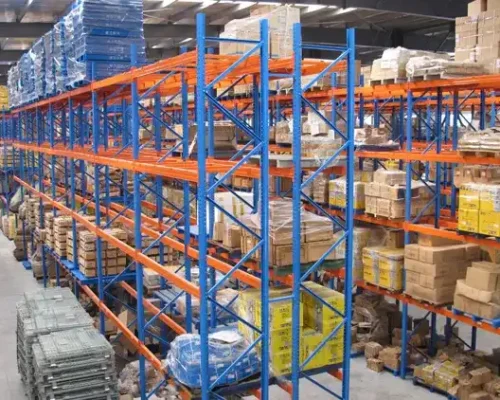
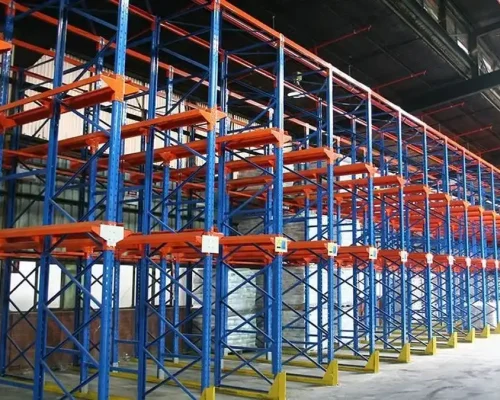
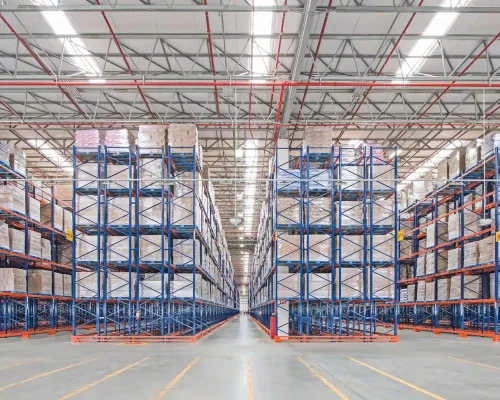
Drive-in racking stands out as the most straightforward and cost-efficient pallet storage solution available. This system comprises multiple racking bays arranged with sequential access channels. Forklift trucks operate directly within the channels to place and retrieve pallets. Compared to conventional pallet racking, this configuration substantially boosts storage density, maximizing warehouse space utilization.

What is Drive-in Racking

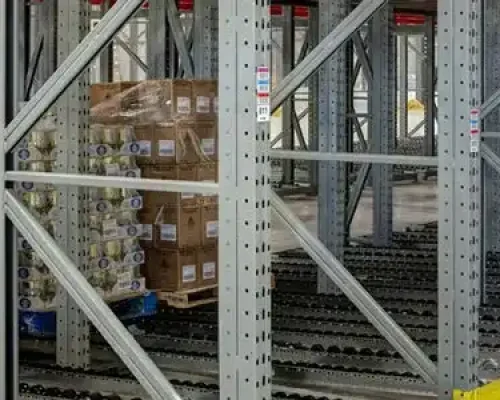
Drive-in racking systems, also referred to as drive-through racking, enable warehouse trucks to enter the rack structure for loading or unloading pallets. Pallets are arranged in sequential front-to-back rows and can be stacked across multiple tiers.

Typically, pallets remain stored within the racking aisles for extended durations. To guarantee safe vehicle maneuverability inside the racks, guide rails are installed on the floor surface.

Features and Benefits

Reduce the risk of damage

Reduce the risk of damage

Using truck and pallet guidance can minimise this further.

Improved Storage Density

Improved Storage Density

Maximizes space utilization by eliminating the need for additional columns per pallet position.

Optimizes space utilization

Optimizes space utilization

Provides higher storage density, resulting in significant space savings.

Types of drive-in racking

Single drive in racking

Single drive-in racking

In single drive-in racking systems, the initial pallet is positioned at location 1. The loading sequence progresses from the bottom to the top and from the rear to the front. For unloading, the operation reverses, moving from the front to the back and from the top to the bottom. This entire process strictly follows the LIFO (Last-In, First-Out) principle.

Double drive in racking

Double drive-in racking

Double drive-in racking mirrors the loading and unloading sequence of single systems. Essentially, it consists of two drive-in racking units arranged back-to-back, doubling the storage density while maintaining the same operational flow and LIFO handling protocol.

Drive through racking

Drive-through racking

In drive-through racking setups, loading occurs from one side while unloading is performed from the opposite side. This design adheres to the FIFO (First-In, First-Out) principle, allowing items to move sequentially through the system for streamlined inventory management.

How Do Drive-in Racking Work?

Drive-in and drive-through methods are employed for loading and unloading tasks in warehouse settings. Within racking systems, load management is governed by the rack configuration.

Access operations for drive-in racking take place solely within a single working aisle. In contrast, drive-through racking relies on two distinct working aisles for its handling processes.

How Do Drive in Racking Work
Pallet Racking Store Solutions

Advantages of Drive-In Racking Systems

  • Maximized Space Utilization
    Fully leverages available floor space and vertical height, significantly increasing storage density versus conventional racking.
  • Simplicity and Cost Efficiency
    As the most straightforward pallet storage solution, it requires minimal capital investment.
  • Adaptable Configuration
    Rack depth and height are customizable to accommodate specific client requirements and product characteristics.
  • Single/Dual Access Flexibility
    Operators can implement either single-aisle (front-load/unload) or dual-aisle configurations (front-load with rear-unload). This versatility adapts to spatial constraints and workflow demands.
  • Streamlined Inventory management
    each lane stores a single SKU, streamlining stock control.

Drive-In Rack System Structure

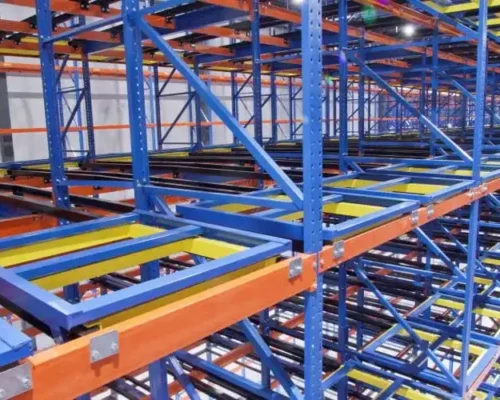
The drive-in storage system integrates multiple frame assemblies and vertical uprights, interlinked to establish internal access channels. This design optimizes space efficiency, making it an ideal solution for homogeneous loads that demand minimal rotation and exclude refrigeration requirements.

Along each lane, support rails are positioned at varied heights on both sides to securely accommodate pallets. During loading and unloading operations, a forklift lifts the unit load above the rails, enters the channel, and facilitates seamless handling.

This compact storage setup enables storage capacity aligned with the number of access lanes, supporting an equal count of SKUs. The depth and height specifications adapt dynamically based on the required pallet quantity for optimal storage.

Drive In Rack System Structure

Drive-In vs. Drive-Through Pallet Racking

Drive-In Racking

Drive-in racking has a single aisle, with the last item in being the first item out. Pallets are loaded and unloaded from the same aisle, thus achieving LIFO inventory management. Drive-in racking features anchor brackets at the rear of the structure for added stability, limiting forklift access. A rear support allows the front to be opened for easy access without compromising structural stability.

Drive In Racking

 Drive-through Racking

Drive-through racking has a single entrance and exit, with the first-in, first-out items arriving first. It utilizes a first-in, first-out (FIFO) principle, with pallets loaded through the front aisle and unloaded through the rear aisle, ensuring the oldest items are picked first.

Two access points provide greater flexibility in loading and unloading pallets from the racking system. Internal anchor brackets provide support for the crossbars and supporting structure, enabling dual-sided access. Because both sides of the rack must be accessible, drive-through systems are best suited for facilities with dual aisle space.

Drive through Racking

Drive-In Racking Queries

1. What is drive-in and drive-through racking?

Drive-in racking stores pallets in depth along a lane accessible only from one entry side, while drive-through racking permits forklift access from both ends to create a flow-through system. Both maximize dense storage for bulk items.

Drive-through pallet racking operates on a First-In-First-Out (FIFO) basis, enabling sequential access to goods via entry and exit points on opposite sides. This design ensures inventory rotation and efficient stock management.

Shuttle racks, drive-in racks, and selective racks are three common types of warehouse storage industrial racks on the market.

Drive-in racking offers high-density storage by eliminating aisles, significantly reducing warehouse space requirements. It optimizes cube utilization for bulk homogeneous goods with lower accessibility needs.

Why Choose Aceally?

Our Advantages

With deep market insights and rich practical experience, we tailor systems to your business needs, ensuring that each solution reflects your unique personality.

Aceally focuses on pioneering innovation and pushing boundaries to optimize your space efficiency and improve operational efficiency. We always strive for excellence, provide a comprehensive product range and insightful guidance.

Our integrated service simplifies the entire process from initial design to final installation, providing an easy and convenient integrated experience.

In addition, we minimize disruptions during the installation of pallet racks through the supervision of experienced installers and certified project managers to ensure a smooth installation process.

Related products

Our Customers

Social media & sharing icons powered by UltimatelySocial
Facebook
X (Twitter)
YouTube
LinkedIn
Scroll to Top

Get A Quotation Now