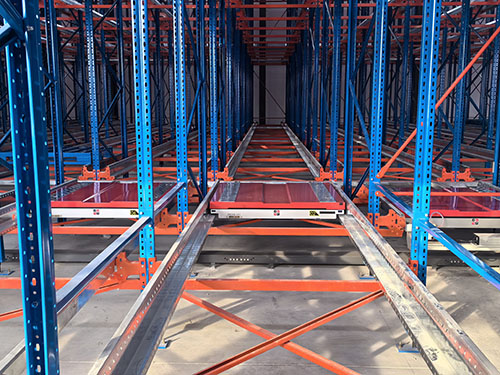


The robustness of a pallet racking system depends on its beams. Choosing the right beam length and knowing its exact load capacity is not just about efficiency, it’s about warehouse safety. If not done correctly, you risk catastrophic racking failure, product damage, serious injury and significant financial loss.
This guide will equip you with the knowledge you need to make informed decisions, prioritize safety, and ensure your racking system operates reliably under load. Let’s take an in-depth look at the relationship between beam length and load capacity.
What is a pallet racking beam?
Pallet racking beams (often referred to as “load beams” or “cross beams”) are horizontal structural members that connect vertical column frames. They form the shelves on which palletized goods are placed. Their main function is to support the weight of the stock and transfer the load safely to the columns and ultimately to the floor. They are the critical interface between the inventory and the racking structure.

Key components of a beam
- Beam length: the main horizontal span. Its profile (shape) and length are the main factors determining its strength.
- Latch/Clip: Hooks or tabs located at each end to securely fasten the beam to the column frame. Compatibility between the beam connectors and the column punch is critical.
- Beam Foot: A shaped end that provides a stable base for a pallet or deck and helps spread the load. Common profiles include stepped beams and box beams.
Common beam types and profiles
- Step beams: Unique “step” profiles made from rolled steel sheets. Suitable for a variety of standard warehouse applications. Load capacity varies with length.
- Box beams: Closed rectangular “box” profiles. Significantly stronger and stiffer than a stepped beam of the same length, resulting in higher load carrying capacity and less deflection. Ideal for carrying heavier loads or longer spans.
- Structural Beam: Made of heavy-duty channel or T-beams, usually welded or bolted together. Provides the highest load carrying capacity and stiffness and is designed for specialized racking such as extra heavy duty applications, long spans or drive-in racking.
How Beam Length is Measured
- Center-to-Center (C-C) Length: This is the standard and critical measurement. It’s the distance between the center points of the two end connectors where they engage with the upright frames.
- Overall Length: The total physical length of the beam from end to end. This is not used for capacity calculations. Always confirm and use the C-C length when selecting beams or referencing capacity charts.
Standard Pallet Racking Beam Lengths
Common C-C lengths are designed around standard pallet sizes (like the ubiquitous 48″ x 40″ / 1200mm x 1000mm) and typical aisle widths:
Typical Range: 72 inches (1829mm), 84 inches (2134mm), 96 inches (2438mm), 108 inches (2743mm), 120 inches (3048mm), 132 inches (3353mm), 144 inches (3658mm) are very common.

Factors affecting the choice of beam length
- Pallet size and overhang: The beam length must be greater than the pallet depth to ensure safe overhang. Insufficient overhang can result in the risk of the pallet tipping or being knocked over.
- Aisle width: Longer beams require wider aisles to ensure safe forklift operation. Choosing the shortest beams that can safely accommodate pallets will optimize storage density.
- Column frame spacing (pallet size): The distance between the front and rear column frames in a pallet directly determines the required crossbar C-C length.
- Building Size and Layout: Columns, walls, and other obstructions can limit where columns can be placed, which affects the choice of joist size and beam length.
- Storage Density: Shorter beams allow for narrower aisles and higher density, but may reduce accessibility. Longer beams require wider aisles, but can sometimes facilitate different picking strategies.
What is Beam Load Capacity?
Beam load capacity refers to the maximum Uniformly Distributed Load (UDL) that a beam of a specific length can safely support across its entire span. This is not a point load capacity. Imagine the weight evenly spread along the beam, not concentrated in one spot. This UDL rating is expressed in pounds per pair (lbs/beam pair) or kilograms per pair (kg/beam pair), as beams are always used in pairs per shelf level.
How Load Capacity is Determined & Rated
Manufacturers engineer beams using specific steel grades, profiles (step, box, structural), and thicknesses (gauges) to achieve defined strength characteristics. Rigorous calculations and testing determine the UDL capacity for each beam length.
Relationship between beam length and load carrying capacity
Longer = weaker, and for a given beam type and cross-section, the load carrying capacity decreases as the beam length increases. This is determined by physical principles – specifically, bending moment. Longer beams are more prone to deflection (sagging) under load-bearing forces, and the stresses within the steel are higher. Doubling the length of a beam reduces its load-bearing capacity by a factor of four or more.
Impact of Beam Type/Profile
- Box Beams: Their closed profile provides superior resistance to bending and torsion compared to open step beams. This allows them to maintain higher UDL capacities at longer spans or support heavier loads at standard spans.
- Structural Beams: Offer the highest capacity-to-length ratios.
Key factors affecting the actual load carrying capacity of beams
Beam Deflection
Deflection is the bending or sagging of a beam under load. While a certain amount of deflection is normal, excessive deflection is dangerous:
It can cause pallets to become unstable, get stuck on columns, or interfere with forklift operations. This indicates that the beam has been subjected to excessive stress
Column Framing Strength
Column framing must be able to withstand the cumulative loads from all beam levels above as well as the beams themselves. The higher the beam loads, the stronger (thicker gauge, larger profile) the columns are required.
Frame spacing and bracing: The distance between frames (along the aisles) and the type of bracing affects the stability and load distribution of the entire system.
Load location
Load capacity ratings assume that the loads are located in the center of the beam and evenly distributed. Off-center loads or point load loads (where heavy loads are concentrated in a small area of the pallet) can cause uneven stresses, which may result in overloading of a beam or part of a beam, leading to failure. Make sure the pallet is structurally sound and centered.
Beam condition
Dents, bends or twists caused by forklift impact can significantly reduce the strength of a beam. Damaged beams must be taken out of service immediately.
Rust can weaken steel over time, especially in harsh environments.
Regular inspections are critical. Bent, cracked or excessively worn end connectors can compromise a strong connection to the column, which is a critical point of failure.
How to choose the right beam length and load capacity: a step-by-step guide
Determine your pallet carrying capacity:
- Maximum Weight: Determine the heaviest pallet load you will store on a single level of beams. Please include pallet weight.
- Size and Stability: Know the length, width and depth of the pallet. Evaluate load stability – unstable loads may require a lower carrying capacity or the use of a deck.
Determine required clear span and C-C length:
- Based on your vertical frame spacing (pallet depth).
Add enough overhang to the pallet depth (at least 3 inches on each side, check with the manufacturer) to obtain the minimum C-C beam length required.
Check the manufacturer’s load chart:
- Get a load chart for the specific racking system or beam supplier you are using.
- Find the beam type/profile you are considering.
- Find the row that corresponds to the desired C-C length.
- Determine the UDL load capacity for that particular beam at that length.
Apply safety margins and verify:
- The UDL load capacity of the beam must be greater than your maximum pallet load weight.
- Do not exceed the rated capacity. Although the rated capacity should already include a safety factor that complies with the standard, consider adding a small safety margin (e.g. 10-15%) for dynamic forces during loading/unloading.
- Dynamic loading: Remember that the forklift will exert additional force when placing/retrieving a load.
Verify upright compatibility and load capacity:
- Ensure that the selected beams are compatible with your upright rack frame (connector type, punch pattern).
- Verify that the upright rack frame has sufficient load capacity to support the accumulated loads from the tiers above, including new beam loads. This usually requires specialized shelf design calculations.
- Prefer UL Listed Beams: Insist on beams with a valid UL Mark (or recognized regional equivalent). This is unquestionable for safety, insurance and liability reasons.
Conclusion
Choosing the right length of pallet racking beams and considering their load capacity is critical to warehouse safety, efficiency and compliance.
When in doubt, consult the experts: work with aceally pallet racking suppliers and qualified racking engineers.