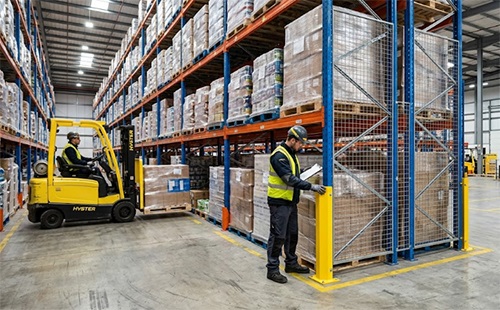


Among the top choices for dynamic, gravity-assisted pallet storage are pallet flow racks and pushback racks. These systems leverage inclined designs to facilitate smooth pallet movement, but they cater to different operational needs based on inventory turnover, space constraints, and product types.
If you’re deciding between pallet flow rack vs pushback rack, this in-depth comparison will help you evaluate their features, benefits, drawbacks, and ideal applications.
Pallet Flow Rack Systems
Pallet flow racks, often referred to as gravity flow systems, are engineered for high-throughput operations where stock rotation is essential. These racks use a series of wheeled or roller tracks installed at a gentle slope—typically between 3% to 5% incline—to allow pallets to glide from the loading end to the unloading end under gravity’s pull.
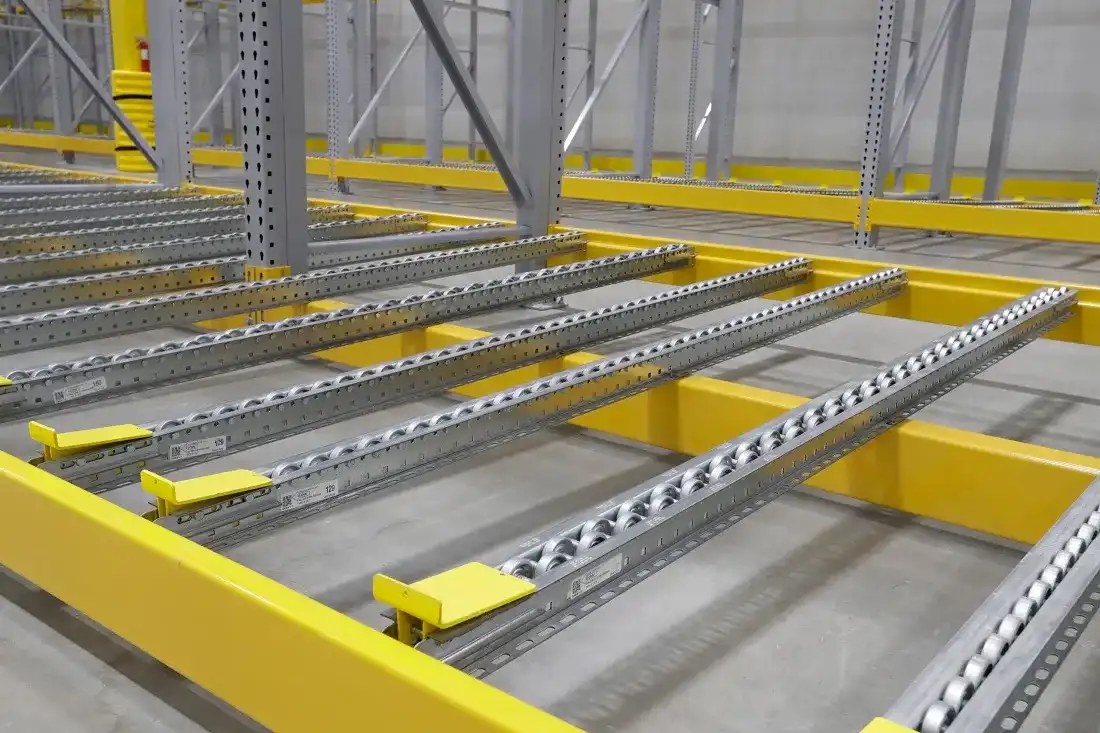
Forklifts place pallets at the higher “charge” side, and gravity propels them forward to the “discharge” side for easy picking. This design supports deep lane storage, often accommodating 10 to 20 pallets per lane, making it perfect for warehouses with limited floor space but high vertical clearance.
Pallet flow systems excel in scenarios involving fast-moving consumer goods (FMCG) or items with strict expiration dates, as they ensure older stock is accessed first.
Pushback Rack Systems
Pushback racks offer a compact alternative, utilizing nested carts on inclined rails to store pallets in a last-in, first-out (LIFO) manner. Each lane features a stack of carts where pallets are loaded from the front using a forklift, pushing previous ones deeper into the system.
Commonly configured for 2 to 6 pallets deep, these systems maximize density by requiring access from only one side—ideal for facilities with walls or columns limiting dual-aisle setups.

Pushback racks can increase storage capacity by 2x to 3x compared to traditional selective racking, while maintaining some selectivity since each lane can hold different SKUs.
Differences: FIFO vs LIFO Inventory Management
One of the primary distinctions lies in how these systems handle stock rotation. Pallet flow operates on a First-In, First-Out (FIFO) principle, where the earliest loaded pallet reaches the pick face first. This is invaluable for industries like food and beverage or pharmaceuticals, where preventing spoilage is key.
In contrast, pushback follows Last-In, First-Out (LIFO), retrieving the most recently added pallet first. While this suits non-perishable items like electronics or hardware, it can lead to inefficiencies if older stock lingers too long.
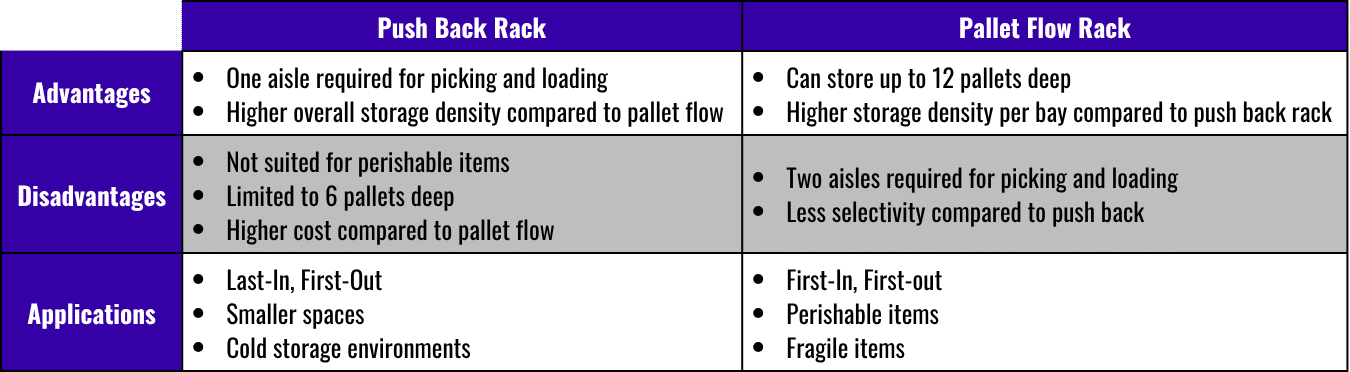
| Aspect | Pallet Flow Rack | Pushback Rack |
|---|---|---|
| Inventory Method | FIFO (First-In, First-Out) | LIFO (Last-In, First-Out) |
| Typical Depth | 10-20 pallets | 2-6 pallets |
| Access Requirements | Dual aisles (load/unload ends) | Single aisle (front only) |
| Ideal for | Perishables, high turnover | Bulk storage, space-constrained |

Advantages and Disadvantages
Pallet Flow Rack Pros and Cons
Pallet flow shines in high-volume environments but isn’t without challenges.
Advantages:
- Enhanced density: Deeper lanes reduce aisle space, boosting overall capacity.
- Automatic rotation: Minimizes manual handling and ensures FIFO compliance.
- Versatility: Handles varied pallet sizes with adjustable rollers.
- Improved throughput: Faster picking as pallets auto-advance to the front.
Disadvantages:
- Higher initial cost due to brakes and controllers.
- Requires clear lanes without obstructions like columns.
- Potential for jams if pallets are inconsistent or damaged.
- Needs two-sided access, limiting placement options.
Pushback Rack Pros and Cons
Advantages:
- Space efficiency: Single-aisle design is great for tight layouts or against walls.
- Quick loading/unloading: Forklifts operate from one face, reducing travel time.
- Lower cost: Often 30-40% cheaper than comparable pallet flow setups.
- Selectivity: Multiple SKUs per bay without full lane clearance.
Disadvantages:
- LIFO limitations: Not suitable for date-sensitive products.
- Depth restrictions: Stacking carts reduces vertical space in deeper configurations.
- Higher maintenance: Carts can wear out faster under heavy use.
Pallet Flow and Pushback Rack Structural Considerations
Pallet flow racks are a staple in distribution centers for groceries or cold storage, where FIFO prevents losses from expired goods. For instance, a large retailer might use them for dairy products, achieving up to 75% space utilization.
Pushback racks thrive in manufacturing or e-commerce warehouses with medium turnover items.
Cost
Budget-wise, pushback systems range from $150 to $300 per pallet position, while pallet flow can hit $200 to $400, factoring in advanced controls.
Safety
Safety is paramount: Pallet flow demands robust brakes to control speeds, especially for heavy loads, while pushback relies on cart stability. Regular inspections for pallet quality.
Maintenance Considerations
Maintenance tips include lubricating rollers quarterly and checking inclines annually. For fire safety, updated NFPA guidelines as of 2025 recommend enhanced sprinklers for deep-lane systems, potentially adding 10-15% to installation costs. Consult local authorities to comply.
Structural and Installation Factors
Building layout influences choice: Pallet flow needs unobstructed paths, making it less ideal around columns, whereas pushback’s flexibility accommodates such interferences. Incline angles (0.3-0.5 inches per foot) must match load weights to ensure smooth operation without excessive speed.
Conclusion
As warehouses automate, integrations with AS/RS (Automated Storage and Retrieval Systems) are on the rise for both racks. Sustainability focuses on recyclable materials in rack construction.
In summary, choosing between pallet flow and pushback racks depends on your inventory needs—FIFO for rotation-critical items or LIFO for density in constrained spaces.
By assessing your operation’s specifics, you can implement a system that boosts efficiency and scales with growth. If you’re planning an upgrade, Please contact us aceally for more assistance.