


Maximizing your warehouse storage capacity forces a critical decision: should you prioritize absolute storage density or maintain immediate access to every pallet?
When your facility reaches its physical limits, expanding the footprint is rarely the most cost-effective first step. Instead, evaluating high-density storage solutions is the logical path forward. Two of the most prominent setups in the industry are Double deep racking and VNA (Very Narrow Aisle) systems. Both methods drastically reduce wasted aisle space compared to standard selective racking, but they operate on entirely different mechanical principles, require different material handling equipment, and serve different inventory profiles.
Here is everything you need to know to evaluate Double deep racking vs VNA (Very Narrow Aisle) systems and determine the exact fit for your operational needs.
As a warehouse racking factory, Aceally works with buyers who need practical, scalable storage systems. If you are comparing double deep racking and VNA (Very Narrow Aisle) systems, the right decision depends on your SKU profile, pallet turnover, available floor area, building height, and budget.
✓Key Takeaways
Space Utilization:
Double deep racking increases storage capacity by 30-40% over standard selective racking, while VNA (Very Narrow Aisle) systems can maximize space utilization by up to 90%.
Accessibility Method:
Double deep racking relies on Last-In, First-Out (LIFO) access, requiring you to move front pallets to reach rear pallets. VNA (Very Narrow Aisle) systems operate on First-In, First-Out (FIFO), providing 100% direct access to every SKU.
Equipment Requirements:
Double deep racking requires standard reach trucks equipped with telescopic forks. VNA (Very Narrow Aisle) systems require highly specialized, wire-guided or rail-guided turret trucks.
Capital Investment:
VNA (Very Narrow Aisle) systems demand a higher initial investment due to specialized machinery and strict floor flatness tolerances, whereas Double deep racking presents a more moderate entry cost.
Best Fit:
Choose Double deep racking for high volumes of fewer SKUs. Choose VNA (Very Narrow Aisle) systems for facilities with high SKU counts, limited floor space, and high vertical clearance.
Understanding the Difference Between Double Deep Racking and VNA (Very Narrow Aisle) Systems
At a high level, both double deep racking and VNA (Very Narrow Aisle) systems help you store more pallets than standard selective pallet racking. The difference is in how double deep racking and VNA (Very Narrow Aisle) systems create density.
What Is Double Deep Racking?
Double deep racking is a warehouse racking system where pallets are stored two positions deep instead of one. This reduces the number of aisles required, which increases storage capacity within the same footprint.
To access the rear pallet, you need to remove the front pallet first. That means double deep racking follows a last-in, first-out (LIFO) handling principle in many applications.
Double deep racking typically requires a reach truck with a telescopic fork or other suitable material handling equipment.
What Are VNA (Very Narrow Aisle) Systems?
VNA (Very Narrow Aisle) systems use aisles that are significantly narrower than those in conventional racking layouts. In many cases, aisle width is around 1.5 to 1.8 meters, depending on truck type and design tolerances.
Because the aisles are so narrow, VNA (Very Narrow Aisle) systems rely on specialized VNA forklifts, often turret trucks or man-up order pickers, sometimes guided by rails or wire systems.
Unlike double deep racking, VNA (Very Narrow Aisle) systems provide direct access to every pallet, making VNA (Very Narrow Aisle) systems a high-selectivity storage solution.
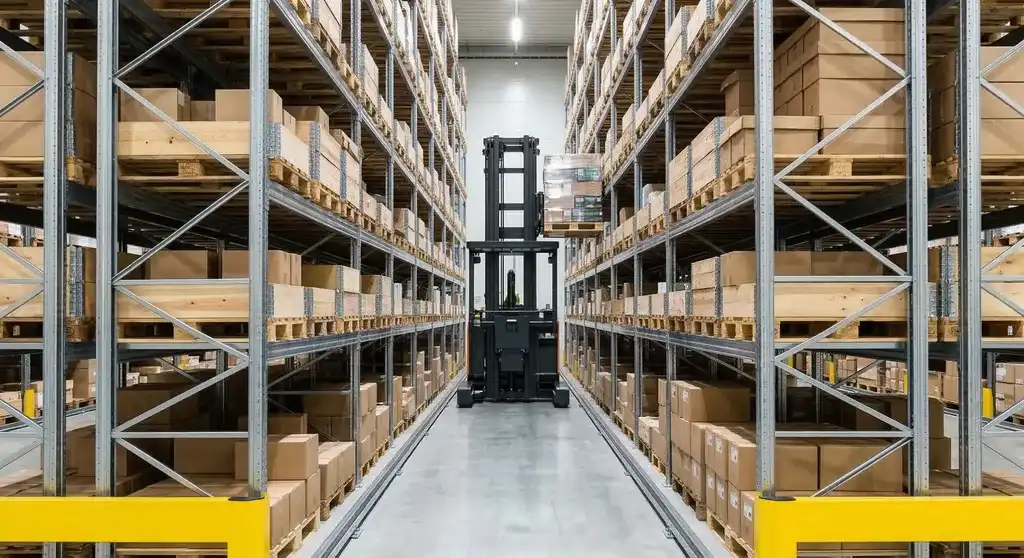
Double Deep Racking vs VNA (Very Narrow Aisle) Systems
| Factor | Double Deep Racking | VNA (Very Narrow Aisle) Systems |
|---|---|---|
| Storage method | Pallets stored two deep | Single-deep access in very narrow aisles |
| Pallet accessibility | Limited | 100% direct access |
| Inventory flow | Usually LIFO | FIFO-friendly |
| Space utilization | Higher than standard selective racking | Very high, often among the highest pallet rack options |
| Aisle width | Wider than VNA (Very Narrow Aisle) systems | Extremely narrow |
| Equipment required | Reach truck with telescopic forks | Specialized VNA truck/turret truck |
| Initial investment | Moderate | High |
| SKU suitability | Fewer SKUs, deeper stock per SKU | Many SKUs, mixed inventory |
| Throughput | Good for batch storage | Good for selective access and organized picking |
| Operational complexity | Moderate | Higher |
How Double Deep Racking Improves Warehouse Density
If your goal is to increase pallet positions without completely changing your warehouse operation, double deep racking can be a practical upgrade.
Reduced Aisles, More Pallet Positions
The biggest benefit of double deep racking comes from cutting down aisle count. Instead of dedicating floor space to multiple access lanes, double deep racking allows you to use more area for pallet storage.
In many warehouse layouts, double deep racking can deliver around 30% to 40% more storage capacity than standard selective pallet racking, depending on beam levels, pallet size, and site configuration.
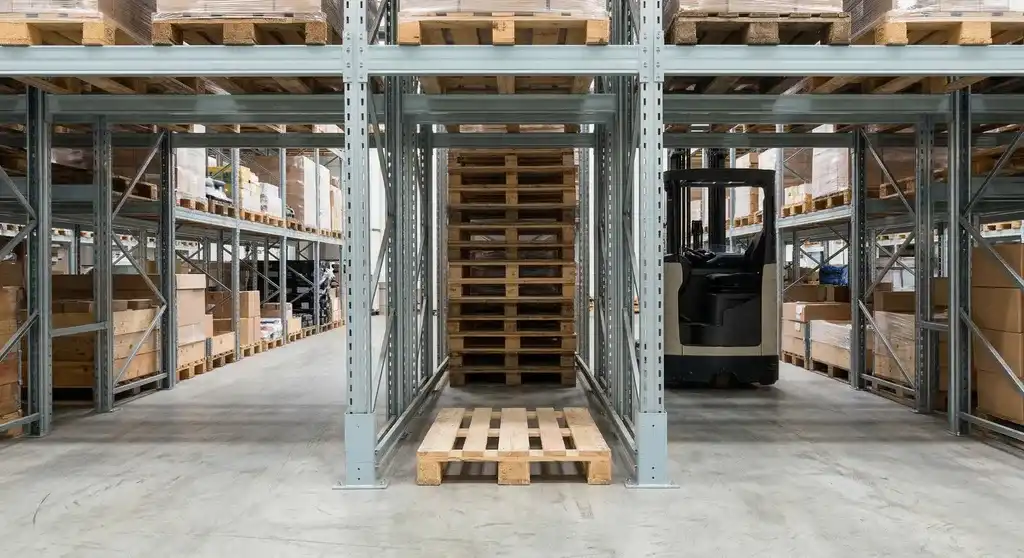
Better Fit for Bulk Inventory
If you store larger quantities of the same SKU, double deep racking can work well because the reduced selectivity is less of a problem. You are not constantly trying to reach many different pallet positions across many product lines.
This makes double deep racking suitable for:
- reserve storage
- buffer stock areas
- distribution centers with repeated pallet loads
- back-of-store or regional supermarket storage
Lower Capital Cost Than VNA (Very Narrow Aisle) Systems
Compared with VNA (Very Narrow Aisle) systems, double deep racking usually requires less structural precision and lower equipment investment. If your budget is controlled but you still want a meaningful density improvement, double deep racking can be an efficient middle-ground solution.
That said, lower upfront cost does not automatically mean lower total cost. If your operation needs frequent access to rear pallets, double deep racking can create extra handling that reduces productivity.
Where Double Deep Racking Falls Short
Limited Selectivity
This is the main trade-off in double deep racking. Since rear pallets are blocked by front pallets, your team cannot access every pallet position immediately.
If your inventory has:
- many SKUs
- short shelf life
- high order variability
- frequent stock rotation requirements
More Product Movement
To retrieve the rear pallet in double deep racking, the front pallet must be moved first. That adds labor time and equipment cycles. Over time, double deep racking can affect throughput and increase forklift activity.
Inventory Discipline Matters
Double deep racking performs best when slotting is planned properly. If product allocation is inconsistent, double deep racking may create trapped inventory positions that reduce efficiency.
This is where warehouse design becomes important. If you are also reviewing broader storage planning, you may want to compare double deep racking with other high-density pallet storage options such as drive-in racking, selective pallet racking, or radio shuttle systems, depending on your turnover profile.
Why VNA (Very Narrow Aisle) Systems Deliver Maximum Accessibility and Space Efficiency
If your warehouse needs to store a high number of pallets while preserving direct access, VNA (Very Narrow Aisle) systems are one of the most effective solutions available.
Narrow Aisles Create More Storage Space
The core advantage of VNA (Very Narrow Aisle) systems is simple: aisles take up less room, so the same building can hold more rack rows and more pallet positions.
A well-designed layout using VNA (Very Narrow Aisle) systems can achieve very high space utilization, especially in tall buildings where vertical cubic capacity is used effectively.
Direct Access to Every Pallet
Unlike double deep racking, VNA (Very Narrow Aisle) systems do not require you to move one pallet to reach another. Every pallet location remains individually accessible.
This makes VNA (Very Narrow Aisle) systems ideal for:
- warehouses with many SKUs
- operations with strict stock rotation
- facilities needing FIFO capability
- environments with active picking and replenishment
Strong Option for High-Bay Warehouses
If you have limited floor space but sufficient building height, VNA (Very Narrow Aisle) systems can unlock much more capacity than broader-aisle systems.
For companies expanding capacity without relocating, VNA (Very Narrow Aisle) systems are often one of the most important options to consider.
The Cost of VNA (Very Narrow Aisle) Systems
Higher Equipment Investment
VNA (Very Narrow Aisle) systems require specialized trucks. These can include:
- turret trucks
- articulated VNA forklifts
- rail-guided or wire-guided equipment
Tighter Floor Tolerances and Installation Standards
Because aisle widths in VNA (Very Narrow Aisle) systems are extremely narrow, floor flatness and installation accuracy matter much more. Any deviation can affect truck movement, safety, and long-term performance.
Operator Training
VNA (Very Narrow Aisle) systems depend heavily on trained operators. If your team is unfamiliar with VNA (Very Narrow Aisle) systems, you will need structured training and clear traffic protocols.
Which Solution Fits Your Operation Better?
| Operational Need | Double Deep Racking | VNA (Very Narrow Aisle) Systems |
|---|---|---|
| Maximize storage without major forklift investment | Strong fit | Possible, but costlier |
| Access every pallet directly | Weak fit | Strong fit |
| Low-to-medium SKU count | Strong fit | Good fit |
| High SKU diversity | Limited fit | Excellent fit |
| Budget-sensitive project | Better choice | Less favorable |
| High-bay warehouse use | Moderate | Excellent |
| Fast stock rotation | Moderate | Strong |
| FIFO requirement | Limited | Better |
| Simplified installation | Easier | More demanding |
| Long-term scalability | Good | Very good if infrastructure supports it |
Double Deep Racking vs VNA (Very Narrow Aisle) Systems: Choosing by Warehouse Profile
Choose Double Deep Racking If You Need Cost-Effective Density
1. Fewer SKUs and Larger Batch Quantities
If each SKU occupies multiple pallets, double deep racking is less likely to create access issues.
2. Moderate Budget Constraints
If you want more pallet positions but are not ready to invest in specialized equipment for VNA (Very Narrow Aisle) systems, double deep racking is often the practical path.
3. Reserve Storage Rather Than Intensive Picking
Double deep racking works especially well for reserve inventory, where immediate access to every pallet is not required.
Choose VNA (Very Narrow Aisle) Systems If You Need Selectivity and High Cube Utilization
1. Many SKUs Requiring Direct Access
If your operation depends on fast retrieval of different items, full selectivity in VNA (Very Narrow Aisle) systems matters.
2. Limited Floor Space
When your site cannot expand outward, VNA (Very Narrow Aisle) systems help you store more within the same footprint.
3. Higher Building Height
The value of VNA (Very Narrow Aisle) systems increases when you can build upward and make full use of vertical space.
Practical Design Considerations Before You Decide
Even the right warehouse racking solution can underperform if the layout is poorly planned. Before moving forward with double deep racking or VNA (Very Narrow Aisle) systems, you should review several design factors.
Pallet Dimensions and Load Stability
Both double deep racking and VNA (Very Narrow Aisle) systems depend on consistent pallet size and load quality. In VNA (Very Narrow Aisle) systems, poor pallet condition becomes a bigger risk because tolerances are tighter. In double deep racking, uneven loads can complicate deep storage handling.
Throughput Expectations
If your inbound and outbound pallet movement is high, handling speed matters as much as density. Neither double deep racking nor VNA (Very Narrow Aisle) systems should be selected based on density alone.
Product Rotation and Shelf Life
If you handle time-sensitive goods, VNA (Very Narrow Aisle) systems are usually safer because VNA (Very Narrow Aisle) systems provide better direct access. Double deep racking can still work, but slotting rules need to be tighter.
Expansion Plans
If your business is growing, double deep racking and VNA (Very Narrow Aisle) systems should both be evaluated for future throughput, automation, and SKU changes. In some cases, an initially cheaper option becomes more expensive later because it limits flexibility.
Why Factory Experience Matters in Racking System Selection
When you compare double deep racking and VNA (Very Narrow Aisle) systems, product specifications alone are not enough. You need a supermarket shelving and warehouse racking factory that understands manufacturing quality, structural design, and real warehouse applications.
At Aceally, we are a supermarket shelving and warehouse racking factory. That matters because the performance of double deep racking and VNA (Very Narrow Aisle) systems depends on:
- steel quality and section design
- load calculation accuracy
- manufacturing consistency
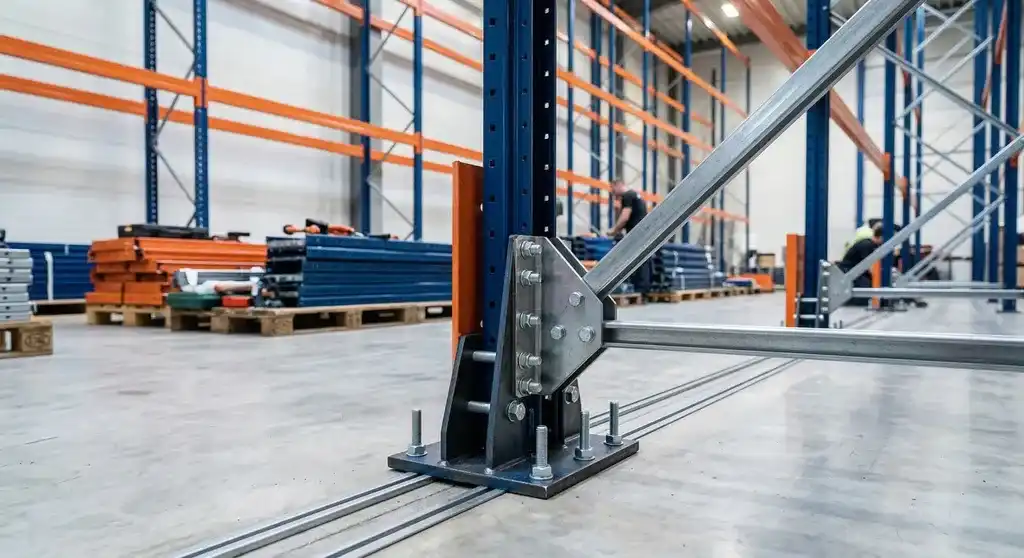
- installation tolerances
- project-specific layout planning
A warehouse racking solution is not just a product—it is an operational infrastructure decision. If the design is wrong, the cost shows up later in damaged pallets, poor accessibility, forklift inefficiency, and avoidable labor.
Conclusion: Double Deep Racking vs VNA (Very Narrow Aisle) Systems
If your warehouse stores fewer SKUs in larger quantities and you want a practical density improvement without the high investment of specialized equipment for VNA (Very Narrow Aisle) systems, double deep racking is often the smarter choice. Double deep racking gives you more pallet capacity than standard selective racking at a more manageable cost, especially for reserve stock and bulk storage environments.
If you need maximum space utilization, direct pallet access, and better support for a wide SKU range, VNA (Very Narrow Aisle) systems usually deliver the stronger long-term value. VNA (Very Narrow Aisle) systems require more planning and more capital, but VNA (Very Narrow Aisle) systems can transform storage performance in facilities where floor space is limited and selectivity is critical.
If you are evaluating a new warehouse layout or replacing an outdated storage system, Aceally can help you compare double deep racking and VNA (Very Narrow Aisle) systems based on your pallet size, warehouse dimensions, throughput targets, and budget. Contact us to discuss your project and get a practical solution from a warehouse racking factory that understands product manufacturing and warehouse operations.
FAQ
What is the main difference between double deep racking and VNA (Very Narrow Aisle) systems?
Double deep racking stores pallets two deep and reduces selectivity, while VNA (Very Narrow Aisle) systems use very narrow aisles to keep direct access to every pallet.
Is double deep racking cheaper than VNA (Very Narrow Aisle) systems?
Yes, in most cases double deep racking has a lower initial cost because double deep racking does not require the same level of specialized equipment and site preparation as VNA (Very Narrow Aisle) systems.
Which solution offers better storage density?
VNA (Very Narrow Aisle) systems typically offer higher overall space utilization, especially in tall warehouses with limited floor area. Double deep racking also improves density, but usually not to the same level.
Does double deep racking require a special forklift?
Yes. Double deep racking usually requires a reach truck or similar forklift with telescopic or deep-reach capability to access rear pallets.
Can VNA (Very Narrow Aisle) systems support FIFO inventory?
Yes. Because every pallet is directly accessible, VNA (Very Narrow Aisle) systems are much better suited to FIFO operations than double deep racking.
Are VNA (Very Narrow Aisle) systems suitable for small warehouses?
VNA (Very Narrow Aisle) systems can be suitable for small warehouses if the available height, throughput, and SKU mix justify the investment. In some smaller facilities, the cost may outweigh the benefits.
Which solution is better for many SKUs?
VNA (Very Narrow Aisle) systems are usually better for warehouses with many SKUs because VNA (Very Narrow Aisle) systems provide full pallet selectivity and faster direct access.
How wide are aisles in VNA (Very Narrow Aisle) systems?
Aisles in VNA (Very Narrow Aisle) systems are commonly around 1.5 to 1.8 meters wide, depending on the truck type, pallet size, and warehouse design requirements.


