

Cold storage is more than just “warehousing at a lower temperature.” Once you step into a frozen environment—especially below -18°C—space optimization is only half the battle. You are fighting energy costs, forklift battery degradation, operator fatigue, and system reliability all at once.
In our experience with cold chain projects, the real bottleneck isn’t just capacity. It’s how fast, how safely, and how consistently you can move pallets when the air is freezing. Here is how the two heavyweights compare in the field.
1. Drive-in Racking: The Traditional Workhorse
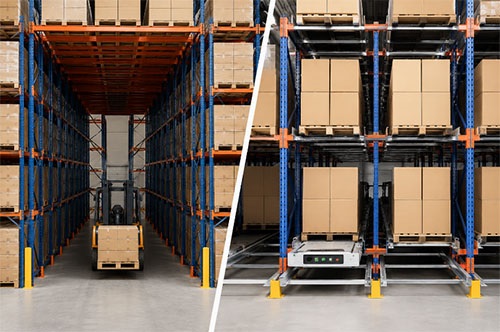
Drive-in racking is the “old guard” of high-density storage. Forklifts drive directly into the rack lanes to deposit or retrieve pallets. By eliminating aisles, it packs a massive amount of product into a small footprint.
- ✔ Best for: Bulk storage, low SKU counts, and long-term frozen goods.
- ✔ The Logic: If your inventory doesn’t move fast, why pay for automation?
The Reality Check in Cold Zones:
While initial investment is low, the hidden “operational tax” is high: safety risks in dark icy lanes, increased operator fatigue at -20°C, and accelerated forklift wear.
2. Shuttle Racking: The Efficiency Specialist
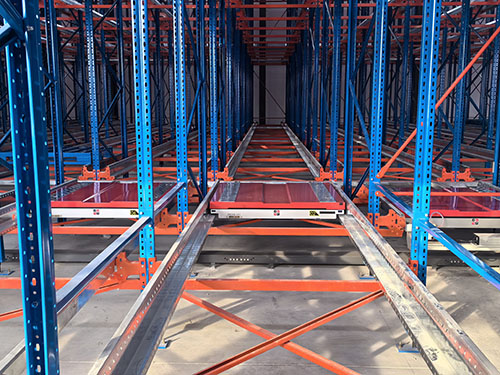
Shuttle racking is a semi-automated system that removes the forklift from the rack lane entirely. A radio-controlled shuttle car does the “deep traveling” for you.
- ✔ Best for: High-throughput distribution, 3PL, and fast-moving frozen foods.
- ✔ The Logic: Keep your forklifts (and people) out of the freezing lanes.
Based on real project data, shuttle systems can reduce forklift travel time inside freezing zones by 70–90%, offering better safety and FIFO/LIFO flexibility.
At a Glance: Key Differences
| Factor | Drive-in Racking | Shuttle Racking |
|---|---|---|
| Storage Density | High | Very High |
| Forklift Entry | Required | Entry Point Only |
| Handling Speed | Slow to Medium | High |
| Damage Risk | High (Impacts) | Very Low |
4. Which One Fits Your Project?
Go with Drive-in Racking if:
- You store large volumes of the same SKU for months.
- Warehouse team is small, and turnover isn’t a daily pressure.
- Upfront capital (CAPEX) is your primary constraint.
Typical Example: Meat or seafood importers holding stock for market price fluctuations.
Go with Shuttle Racking if:
- You run high-frequency inbound/outbound cycles.
- Labor costs or operator safety are significant concerns.
- You need to maximize every cubic meter of expensive cold space.
Typical Example: FMCG frozen food distributors supplying retail chains daily.
5. The “Hidden” Cost of Movement
Most buyers focus on the price per pallet position. But in cold storage, the cost of movement is where you win or lose. Every minute a forklift spends idling or traveling inside a -20°C zone drains the battery faster and increases the risk of accidents. Shuttle systems aren’t just about “more pallets”—they are about reducing the time your expensive assets spend in the cold.
Final Conclusion
If your project is long-term and cost-sensitive, Drive-in remains a solid choice. However, for modern frozen distribution hubs where efficiency and throughput are critical, Shuttle Racking is increasingly becoming the industry standard.
Need a Layout Recommendation?
Every facility has a unique SKU structure. Let our engineers help you run the numbers on pallet flow and ROI.