


One of the most critical aspects of warehouse planning is determining the appropriate forklift aisle width. Properly calculated aisle width can enhance safety, maximize storage capacity, and improve operational efficiency.
In this detailed guide, we’ll explore how to calculate forklift aisle width, the factors that influence these calculations, aisle configuration types, and their impact on warehouse performance.
Why Forklift Aisle Widths Matter in Warehouse Design
The layout of a warehouse directly affects its operational efficiency, safety, and overall productivity. Forklift aisle widths play a central role in this equation, as they determine how easily forklifts can navigate, access inventory, and transport goods. Incorrect aisle widths can lead to inefficiencies, safety hazards, or underutilized space, all of which can negatively impact your bottom line.
- Safety First: Aisles that are too narrow can increase the risk of collisions between forklifts, racking systems, or stored goods, endangering workers and damaging equipment.
- Operational Efficiency: Properly sized aisles allow forklifts to move quickly and smoothly, reducing travel time and boosting productivity.
- Storage Optimization: The right aisle width balances the need for maneuverability with the goal of maximizing storage density, ensuring you make the most of your available space.
- Cost Management: Overly wide aisles waste valuable floor space, increasing rent or construction costs, while overly narrow aisles may require costly specialized equipment.

How to Calculate Minimum Forklift Aisle Widths
Determining the minimum aisle width for your warehouse involves a straightforward yet critical formula that accounts for the dimensions of your forklift, the load, and additional clearance requirements. Below is the step-by-step process to calculate the minimum aisle width:
Formula for Minimum Aisle Width
Minimum Aisle Width = Forklift Width + Load Width + Pallet Overhang + Safety Clearance
- Forklift Width: Measure the total width of the forklift, including any attachments (e.g., side-shifters or extended forks). This is the base measurement, as the forklift must fit comfortably within the aisle.
- Load Width: Account for the width of the largest load the forklift will carry, typically a standard pallet. For example, a standard GMA pallet in the U.S. measures 48 inches wide by 40 inches deep.
- Pallet Overhang: This refers to any part of the load that extends beyond the pallet or forklift forks. A typical overhang is 2–4 inches on each side, depending on the load configuration.
- Safety Clearance: Add extra space to ensure safe maneuverability and to account for operator error or slight misalignments. A common safety clearance is 6–12 inches on each side, depending on the forklift type and warehouse conditions.
Example Calculation
Suppose you’re using a standard counterbalance forklift with a width of 48 inches, handling a 48-inch-wide pallet with a 2-inch overhang on each side, and you want to include 6 inches of safety clearance on each side:
- Forklift Width: 48 inches
- Load Width: 48 inches
- Pallet Overhang: 2 inches + 2 inches = 4 inches
- Safety Clearance: 6 inches + 6 inches = 12 inches
Minimum Aisle Width = 48 + 48 + 4 + 12 = 112 inches (or approximately 9.3 feet)
This calculation provides the minimum aisle width required for safe and efficient forklift operation. However, other factors, such as the type of forklift, racking system, and warehouse layout, may necessitate adjustments.
Factors to Consider When Calculating Aisle Widths
While the formula provides a starting point, several variables influence the final aisle width. Understanding these factors ensures your calculations align with your warehouse’s unique requirements.
1. Forklift Type
Different forklifts have varying dimensions and turning radii, which directly impact aisle width requirements. Common forklift types include:
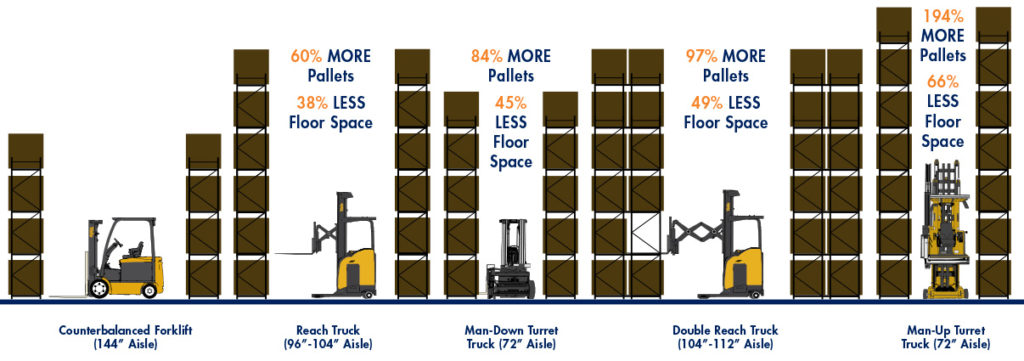
- Counterbalance Forklifts: These are the most common forklifts, requiring wider aisles (typically 10–12 feet) due to their larger turning radius.
- Reach Trucks: Designed for narrow aisles (8–10 feet), reach trucks have a smaller footprint and can extend their forks to access high racks.
- Order Pickers: Used in narrow aisles, these forklifts allow operators to pick individual items from high racks, requiring aisles of 8–10 feet.
- Very Narrow Aisle (VNA) Forklifts: These specialized forklifts, often wire- or rail-guided, operate in aisles as narrow as 5–6 feet, maximizing storage density.
- Pallet Jacks: Ideal for very narrow aisles, pallet jacks are compact and require minimal space (5–6 feet).

2. Racking System
The type of racking system influences aisle width requirements. For example:
- Selective Racking: Used in wide aisles, allowing easy access to every pallet.
- Narrow Aisle Racking: Designed for reach trucks or order pickers, offering higher storage density.
- Very Narrow Aisle (VNA) Racking: Optimized for VNA forklifts, maximizing vertical and horizontal space.
- Drive-In or Push-Back Racking: Eliminates aisles entirely or reduces their width, ideal for high-density storage.
3. Load Dimensions
The size and weight of the products being stored impact aisle width. Larger or irregularly shaped loads may require wider aisles to accommodate safe handling.
4. Warehouse Height
Taller racking systems require forklifts with higher reach capabilities, which may necessitate narrower aisles to maximize vertical storage. For example, VNA racking systems can reach up to 40 feet, but they require specialized forklifts and precise guidance systems.
5. Operational Requirements
Consider the frequency of inventory turnover, the speed of operations, and the need for accessibility. High-traffic warehouses may benefit from slightly wider aisles to accommodate multiple forklifts or faster movement.
Common Forklift Aisle Width Configurations
Warehouse aisle widths are typically categorized into three types, each suited to specific operational needs and forklift types. Below, we explore these configurations in detail.
1. Wide Aisles (10–12 Feet)
Wide aisles are the most traditional and versatile option, accommodating standard counterbalance forklifts. They are ideal for:
- Warehouses with frequent inventory access.
- Facilities handling large or bulky items.
- Operations using standard pallet racking.
Advantages:
- Easy maneuverability for standard forklifts.
- Lower training requirements for operators.
- Reduced risk of collisions or damage.
Disadvantages:
- Lower storage density due to wider aisles.
- Increased floor space requirements, raising costs.
2. Narrow Aisles (8–10 Feet)
Narrow aisles are designed for reach trucks or order pickers, offering a balance between storage density and accessibility. They are commonly used in:
- E-commerce warehouses with high SKU counts.
- Manufacturing facilities with limited floor space.
Advantages:
- Increased storage capacity compared to wide aisles.
- Suitable for high racks (up to 40 feet).
- Improved efficiency for high-turnover operations.
Disadvantages:
- Requires specialized forklifts, increasing equipment costs.
- Operators may need additional training for precise navigation.
3. Very Narrow Aisles (VNA) (5–6 Feet)
Very narrow aisles are the pinnacle of storage density, designed for specialized VNA forklifts with wire or rail guidance systems. They are ideal for:
- High-density storage facilities.
- Automated storage and retrieval systems (AS/RS).
Advantages:
- Maximizes storage capacity, especially in small footprints.
- Optimizes vertical space with racks up to 40 feet.
- High precision reduces accidents when paired with guidance systems.
Disadvantages:
- High initial costs for specialized forklifts and guidance systems.
- Limited flexibility for handling oversized loads.
Chart: Comparison of Aisle Width Configurations
To visualize the differences between aisle types, here’s a chart comparing their key characteristics:
| Aisle Type | Aisle Width (Feet) |
|---|---|
| Wide Aisles | 11 |
| Narrow Aisles | 9 |
| Very Narrow Aisles | 5.5 |
This chart illustrates the decreasing aisle widths as you move from wide to very narrow configurations, highlighting the trade-off between space and maneuverability.
Advantages of Optimizing Forklift Aisle Width
Optimizing aisle widths can revolutionize your warehouse operations by delivering numerous benefits.
1. Maximized Storage Capacity
Narrower aisles allow for more racking systems within the same floor space, increasing storage density. This is particularly valuable for businesses with limited warehouse space or those looking to avoid costly expansions.
2. Enhanced Operational Efficiency
By reducing the distance forklifts need to travel, narrower aisles can streamline operations, leading to faster order fulfillment and higher productivity. This is especially critical in high-volume warehouses.
3. Cost Savings
Optimized aisle widths reduce the need for excessive floor space, lowering rent or construction costs. Additionally, improved efficiency can decrease labor and equipment maintenance expenses.
4. Improved Safety
While narrow aisles require skilled operators, they can reduce forklift speeds, minimizing the risk of accidents. Guidance systems in VNA setups further enhance precision and safety.
5. Flexibility for Changing Needs
Narrow aisle systems, particularly those with adjustable racking, allow businesses to adapt to fluctuating inventory demands or seasonal variations.
Additional Strategies to Increase Storage Density
Beyond optimizing aisle widths, businesses can employ other strategies to maximize warehouse storage capacity:
- Vertical Storage Solutions: Utilize high-bay racking or AS/RS to take advantage of vertical space, especially in warehouses with high ceilings.
- Double-Deep Racking: Store two pallets back-to-back to double storage capacity without increasing aisle width.
- Drive-In Racking: Eliminate aisles by allowing forklifts to drive directly into the racking system, ideal for last-in, first-out (LIFO) inventory.
- Push-Back Racking: Use carts on rails to store multiple pallets in a single lane, optimizing space for bulk storage.
Choosing the Right Racking and Forklift System
Selecting the appropriate racking and forklift system is crucial for achieving optimal aisle widths.
- Assess Your Inventory: Consider the size, weight, and turnover rate of your products. Fragile or oversized items may require wider aisles, while uniform pallets can work in narrower setups.
- Evaluate Forklift Options: Match your forklift type to your racking system and aisle width. For example, VNA forklifts are ideal for high-density storage but require significant investment.
- Consult a Professional: Work with an Aceally racking manufacturer to create a custom layout that balances storage, efficiency, and security.
- Plan for Scalability: Choose flexible systems that can adapt to future growth or changes in inventory requirements.
Conclusion
Calculating forklift aisle width is a fundamental step in designing an efficient, safe, and cost-effective warehouse. By understanding the formula for minimum aisle width, considering key factors like forklift type and racking system, and exploring various aisle configurations, businesses can optimize their warehouse layout to meet their unique needs. Whether you choose wide, narrow, or very narrow aisles, the goal is to strike a balance between storage density, operational efficiency, and safety.
For businesses looking to take their warehouse design to the next level, partnering with an Aceally pallet racking manufacturer ensures a customized solution that maximizes space utilization and enhances performance. By carefully planning forklift aisle width and storage systems, you can create a warehouse that not only meets current needs but also accommodates future growth.
For more custom pallet racking advice or to explore warehouse solutions that align with your business goals, contact us today.


