


When you need to maximize your warehouse storage by building upwards, Narrow Aisle Racking (NAR) and Very Narrow Aisle (VNA) Racking emerge as two highly effective options. While their names hint at similarities, you must grasp the significant differences in their design and operation. Recognizing these distinctions is vital for choosing the ideal system that perfectly fits your specific space constraints and workflow demands.
I. Understanding Narrow Aisle Configurations
Tall warehouse ceilings offer you a prime opportunity to capitalize on vertical space. Narrow aisle storage layouts unlock this potential by installing taller racking structures within significantly reduced aisle widths. Compared to traditional wide-aisle setups, this approach allows you to incorporate more storage rows and add extra levels vertically.
You gain the ability to replicate your floor space’s functionality multiple times over without expanding your building’s footprint. This represents a significant leap forward in space optimization, helping you avoid issues like misplaced inventory or operational bottlenecks, leading to more streamlined warehouse management.
II. The difference between Narrow Aisle Racking (NAR) and Very Narrow Aisle Racking (VNA)
When you plan to optimize your warehouse layout, both NAR (Narrow Aisle Racking) and VNA (Very Narrow Aisle) systems help you make the most of vertical height and floor space while ensuring every pallet is instantly accessible. Yet, they vary in key features like aisle dimensions and forklift needs, as outlined below.
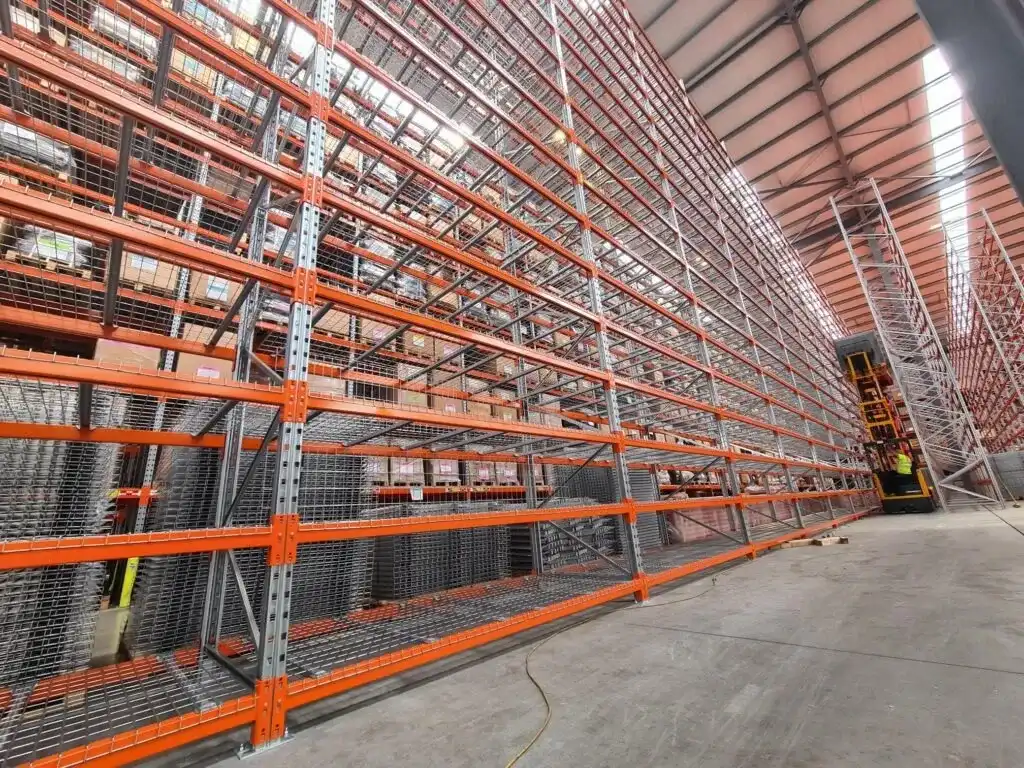
1.) Aisle Width
For NAR setups, you’ll typically work with aisles around 2.9 meters wide, which is narrower than conventional wide-aisle systems that often span 3.5 to 4 meters. This reduction allows for better space efficiency without compromising access.
In VNA configurations, you can achieve even slimmer aisles, sometimes as tight as 1.5 meters, giving you a more compact footprint compared to NAR options for high-density storage.
2.) Forklifts
With NAR, you rely on standard-sized forklifts equipped with extended reach to handle top-level pallets easily. These machines can turn within the aisles, and their side-positioned seats boost your visibility for safer maneuvering.
For VNA, you need specialized guided forklifts, ideal for taller racking heights. They use wire guidance to avoid rack collisions, and with “intelligent” forks, turning isn’t required—keeping the aisle and forklift widths identical for seamless operation
3.) Storage Density
When you explore Narrow Aisle Racking (NAR), you’ll notice that its aisle width is more compact than VNA systems, which reduces the number of rows it can hold per area. However, compared to conventional wide-aisle configurations, NAR maximizes row capacity within a fixed footprint, offering you a highly efficient space-saving storage approach.
For Very Narrow Aisle (VNA) racking, you’ll find the aisles are exceptionally tight, even to NAR standards, allowing for more rows per square meter. This design positions VNA as the top choice for achieving the highest storage density in your facility.
4.) Cost
With NAR systems, you typically face a lower initial outlay than with VNA, as VNA incorporates additional rack components. Yet, you must invest in specialized handling gear, such as reach trucks or flexi forklifts, to operate effectively.
For VNA setups, you need dedicated trucks equipped with guidance systems, leading to a higher upfront investment compared to NAR. Over the long term, though, you benefit from enhanced operational efficiency and significant space conservation, making this a worthwhile expenditure for your storage
5.) Operational Efficiency in Warehouse Racking
When you implement Narrow Aisle Racking (NAR), your operators must handle pallet placement and retrieval with heightened care. Maneuvering through confined pathways can slow down the entire process compared to broader aisle setups, as it demands precise navigation to avoid delays.
For Very Narrow Aisle (VNA) systems, using specialized handling equipment in tightly packed racks often extends pallet handling times. This integration enhances your overall operational speed and efficiency, while reducing the risk of damage.
Both NAR and VNA solutions excel at optimizing vertical storage while making the most of your floor space. Yet, choosing the right system hinges on your specific factors, such as available area, budget constraints, and target efficiency goals.
III. Advantages of Narrow Aisle Racking Configuration
Implementing narrow aisle racking with taller shelves offers a practical and widely adopted strategy for your operations. It enables you to expand warehouse storage capacity, improve efficiency, and promote better organization without increasing the physical area of your current space.
Improve storage capacity – You can significantly boost your storage potential by minimizing the width of aisles between rack rows, which allows for more rows to be added. When you combine this with raising rack heights through additional levels, your overall storage capacity sees a substantial improvement.
Utilize unused space – Maximizing unused vertical space becomes crucial for optimizing your facility’s efficiency, as this dimension is just as valuable as floor area. Taller racks make the most of overhead space, especially when ground-level real estate is limited, helping you utilize every inch effectively.
High-density storage solutions – With this high-density storage solution, you gain direct access to every pallet, ensuring 100% selectivity without requiring long, crowded aisles. Each pallet remains fully visible from the narrow pathways, allowing you to pick any item quickly and without obstruction.
Cost savings – You save on costs by achieving higher storage density through narrower aisles and elevated racks, all while maintaining the same physical footprint. This approach avoids the expense of building expansions or the financial burden of relocating to a larger site.
Improve efficiency – Enhance efficiency during peak demand or growth periods by stacking pallets higher, which mitigates challenges from limited floor space. Additional storage locations help you manage pallets in an organized, streamlined way for smoother placement and retrieval.
Improved safety – Improve safety by reducing collision risks, since aisles don’t accommodate multiple vehicles moving in various directions. Forklifts navigate precisely between rack rows, aided by smooth floors, guided systems like wires or rails, and enhanced operator visibility through features such as side seats, cameras, or lifting devices based on aisle width and equipment

IV. Planning Essentials for Narrow Aisle Systems:
When implementing a narrow aisle system, you must evaluate your warehouse’s height and available floor space. Taller ceilings amplify the advantages of this setup, but if both vertical and ground areas are limited, more compact alternatives like deep-lane pallet racking could be a better fit for your needs.
Assess the condition of your flooring carefully – Uneven surfaces can lead to rack tilting, creating safety hazards, particularly when reach trucks operate near the top levels. For smooth operations, ensure both the racks and forklifts remain perfectly level; if the ground isn’t flat, prioritize leveling it to achieve a uniform surface.
Factor in your budget constraints – Specialized VNA (Very Narrow Aisle) forklifts often involve upfront costs, which might be offset by gains in efficiency and safety over time. However, you should include this initial investment in your overall system expenses to avoid surprises.
Identify the types of products you’ll be storing – If pallet dimensions vary or are inconsistent, narrow aisle configurations may struggle to handle irregularly shaped or oversized items, potentially limiting their suitability for your inventory.
V. Conclusion
Are you exploring ways to minimize aisle widths and boost shelf elevations in your storage facility? Feeling frustrated by tight passageways and wasted vertical space overhead? Wondering if narrow aisle racking systems could effectively address these inefficiencies?
Contact Us! Simply provide a few essential details, and we’ll deliver a preliminary cost assessment. Or, if you’d like, we can craft a detailed proposal with a full quote. No matter your choice, we’re dedicated to assisting you in identifying the ideal solution, customized precisely to your spatial constraints, operational goals, and financial parameters


