

If you are planning a warehouse facility in a seismically active region, understanding pallet rack seismic requirements is not optional—it is the foundation of your legal compliance and operational safety. Ignoring the specific engineering mandates of the International Building Code (IBC) and RMI standards can lead to failed inspections, indefinite project delays, and the inability to secure a certificate of occupancy.
For procurement managers and facility owners, the goal is clear: sourcing reliable seismic pallet rack systems for sale that not only maximize density but also withstand ground acceleration forces without catastrophic failure.
Key Takeaways
- Location Design: Your specific Zip Code and soil classification determine the steel gauge and engineering required.
- Permits Are Mandatory: You cannot legally install racking in high-seismic areas without PE (Professional Engineer) stamped drawings.
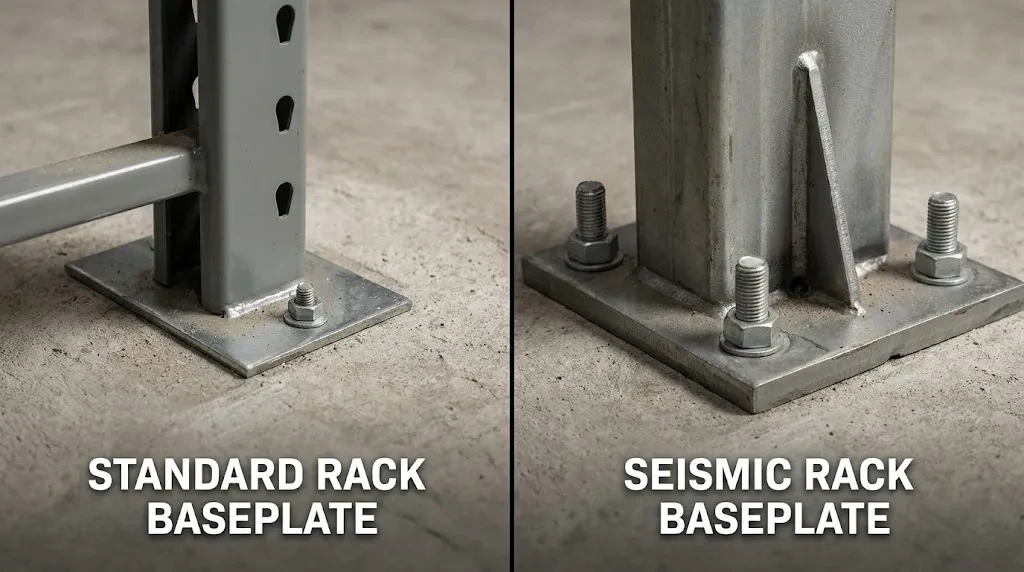
- Hardware Differences: Seismic racks require larger baseplates, heavier anchoring, and specific beam connectors compared to standard racks.
- Cost Implications: Expect a 15-30% cost variance for seismic upgrades, which is an investment in asset protection and liability reduction.
- Concrete Matters: The thickness and PSI rating of your warehouse floor are just as critical as the rack steel itself.
Is Your Warehouse in a Seismic Design Category?
[lr_layout image=”/wp-content/uploads/2026/01/USGS-seismic-design-category-map-for-warehouse-planning.webp” alt=”USGS seismic design category map for warehouse planning”] Many facility managers operate under the misconception that seismic racking is only a requirement for California or the Pacific Northwest. While the West Coast is indeed a high-activity zone, the United States Geological Survey (USGS) identifies seismic risks in areas like the New Madrid Seismic Zone (spanning parts of Missouri, Arkansas, and Tennessee) and Charleston, South Carolina.Current building codes have moved away from simple “Zones 1-4” terminology. Today, engineers use Seismic Design Categories (SDC) ranging from A (very low potential) to F (very high potential).
[/lr_layout]
How Location Impacts Pallet Rack Pricing
When you request a custom warehouse rack quote, the first thing experienced rack suppliers will ask for is the exact address of the installation. This is because seismic forces are calculated based on ground acceleration parameters specific to that location. For general pricing benchmarks, see our comprehensive cost breakdown.
A rack system engineered for a facility in Los Angeles (SDC E) requires significantly more steel, heavier bracing, and more complex engineering than a system in Chicago (SDC A). If you move used racking from a low-risk zone to a high-risk zone, it will almost certainly fail to meet code requirements. You cannot simply “eyeball” the structural integrity; it requires precise calculation.
[Internal Link: Learn more about how location impacts warehouse design in our Guide to Warehouse Site Selection.]Note for Buyers: If a vendor gives you a quote without asking for your facility’s address and slab details, they are likely quoting a standard system that may not pass the permitting process.
PE Stamped Drawings and Permitting
[lr_layout image=”/wp-content/uploads/2026/01/PE-stamped-engineering-drawings-for-pallet-rack-permit.webp” alt=”PE stamped engineering drawings for pallet rack permit”] In the world of industrial storage, the physical steel is only half the product. The other half is the engineering package. To legally install pallet rack seismic requirements compliant systems, you must submit a permit application to your local municipality. Learn more about comprehensive pallet rack safety protocols that complement seismic compliance.Your local building department or Fire Marshal will require a set of calculations and drawings stamped by a Professional Engineer (PE) licensed in the state where the rack is being installed.
[/lr_layout]
Navigating the Permit Process
The permit process verifies that your system can handle two main types of loading:
- Gravity Load: The weight of the pallets sitting on the beams.
- Lateral Load: The side-to-side force generated during an earthquake.
Standard storage products are designed primarily for gravity loads. In contrast, professionally engineered seismic rack systems are designed to resist the “uplift” and “shear” forces that occur when the ground moves beneath the rack. Without the PE stamp certifying these calculations, your installation will be red-tagged, forcing you to dismantle the system. This is a massive financial risk that can be avoided by ensuring your supplier includes permitting services in their scope of work.
[Internal Link: Understand ongoing inspection obligations after installation to maintain compliance.]Seismic vs. Standard Racking
Visually, a seismic rack might look similar to a standard rack to the untrained eye, but the hardware specifications are distinct. The engineering goal is to create a structure that is ductile enough to absorb energy but rigid enough to prevent collapse.
To help you identify what you are paying for, we have broken down the hardware differences below.
Comparison: Standard vs. Seismic Rack Specifications
| Feature | Standard Racking (Low Seismic) | Seismic Racking (High Seismic) |
| Baseplate Size | Standard 3″ x 5″ or 4″ x 5″ | Enlarged 5″ x 7″, 6″ x 8″, or larger to distribute load. |
| Baseplate Thickness | Typically 10 to 12 gauge | 3/8″, 1/2″, or thicker steel plate. |
| Anchorage | 1 anchor bolt per column (1/2″ diameter) | 2 or more anchors per column (1/2″ to 3/4″ diameter), often with deeper embedment. |
| Upright Frames | Standard open-column design | May utilize closed-tube columns or reinforced bracing patterns (Z-bracing). |
| Beam Connectors | Standard teardrop or pin locking | heavy-duty locking mechanisms with 3-4 rivets/pins per connector. |
| Aisle Spacing | Standard width (8-10 ft) | May require wider flues (spacing between racks) to prevent collision during swaying. |
The Critical Role of Baseplates and Anchors
The connection between the rack upright and the concrete floor is the most critical stress point during a seismic event. When the ground shakes, the rack wants to tip over (uplift) and slide (shear).
To counteract this, seismic baseplates are much larger and thicker. They accommodate multiple anchor bolts—often specified as high-strength “wedge anchors” or epoxy anchors—that are drilled deep into the concrete. If your warehouse floor slab is not thick enough (e.g., less than 6 inches) or lacks sufficient PSI strength, you may need to pour new concrete footings before installation can proceed. This is why obtaining slab specs early is vital.
RMI Standards and ANSI MH16.1
You will frequently see references to RMI (Rack Manufacturers Institute) and ANSI MH16.1 in technical documentation. As a buyer, you don’t need to memorize the formulas, but you should understand their authority.
The ANSI MH16.1: Specification for the Design, Testing, and Utilization of Industrial Steel Storage Racks is the reference standard adopted by the International Building Code. It dictates exactly how engineers must calculate the seismic base shear and the safety factors for steel storage racks.
When you purchase a system, your purchase order should explicitly state: “System to be designed and installed in accordance with current ANSI MH16.1 and local building code requirements.” For a detailed breakdown of ANSI MH16.1 compliance standards, refer to our technical guide.
The Hidden Commercial Risks of Non-Compliance
Investing in seismic-compliant racking is not just about satisfying a government inspector; it is a strategic business decision. The cost difference for a seismic upgrade usually falls between 15% and 30% over a standard system, depending on the severity of the zone. However, the cost of non-compliance is exponentially higher.
Liability and Asset Protection
If an earthquake occurs and a non-compliant rack collapses, the immediate loss includes the inventory itself, which can be valued in the millions. However, the secondary costs are often more damaging:
- Business Interruption: You cannot ship product if your warehouse is a disaster zone.
- Workers’ Compensation: Injuries or fatalities caused by negligence (using non-rated racks in a seismic zone) can lead to severe lawsuits and OSHA penalties and compliance requirements.
- Replacement Costs: You will have to buy the racking system twice—once for the mistake, and once to do it right.
High-density storage systems, such as Drive-In or Push-Back racks, are particularly vulnerable to seismic forces due to their weight and height. For these systems, the engineering scrutiny is even higher.
[Internal Link: Compare high-density options in our article on Drive-In vs. Push-Back Racking Systems.]How to Buy Industrial Seismic Racks: A Step-by-Step Approach
To ensure your project runs smoothly and passes all inspections, follow this procurement workflow.
1. Gather Your Facility Data
Before contacting suppliers, obtain the “Slab Drawings” for your building. You need to know the concrete thickness (e.g., 6 inches), the reinforcement type (rebar or mesh), and the soil bearing capacity. If you don’t have this, you may need a core drill test.
2. Define the Load
Be precise about your pallet weights. A rack designed for 2,000 lb pallets performs differently than one designed for 2,500 lb pallets during a seismic event. Overestimating loads drives up costs unnecessarily; underestimating them creates safety risks.
3. Request a Detailed Proposal
Ask your rack distributor for a preliminary seismic analysis included in your purchase proposal. They should be able to look up your address and tell you the Seismic Design Category and anticipated hardware changes (e.g., “You will need 5×8 baseplates for this location”).
4. Verify the PE Stamp
Ensure the final quote includes the cost of the PE stamped engineering package. Do not accept a handshake agreement on this. The physical drawing with the state seal is the only document the city cares about.
Conclusion
Securing the right pallet rack seismic requirements for your facility is a balance of engineering precision and strategic procurement. It requires navigating complex building codes, understanding your specific geographic risks, and ensuring that every bolt and beam is rated for the task. You are not just buying steel; you are buying a certified, legally compliant infrastructure that protects your people and your bottom line.
If you are unsure about the seismic requirements for your specific warehouse location or need a custom pallet racking quote that guarantees permit approval, we are here to help. As experienced warehouse storage system experts, our team works directly with licensed Professional Engineers to design systems that meet strict RMI and IBC standards. Contact us today to discuss your project and secure a storage solution built on solid ground.