

Launching a supermarket venture demands careful attention to foundational elements like shelving systems and layout designs, but overlooking the role of shopping carts can hinder smooth operations from day one. These indispensable tools not only facilitate customer navigation through aisles but also influence overall store efficiency and satisfaction levels.
In the competitive world of retail, shopping carts serve as silent partners in the customer journey, allowing seamless collection of items from diverse sections. Supermarket entrepreneurs, chain operators, and bulk procurers must grasp the financial implications of acquiring these assets to align with fiscal strategies and long-term growth objectives.
This comprehensive guide delves into the diverse categories of supermarket shopping carts, their associated pricing structures, underlying manufacturing expenses, upkeep requirements, and strategic selection tips. Our goal is to equip you with actionable insights that optimize shopper interactions while supporting sustainable revenue streams.
What Are Shopping Carts?
Shopping carts, frequently referred to as trolleys in certain regions, function as mobile carriers on wheels, empowering shoppers to gather and move merchandise effortlessly across retail floors. In the context of supermarkets, they play a pivotal role in simplifying the entire purchasing workflow, handling everything from lightweight perishables to heavier bulk goods without strain.
Contemporary designs prioritize not just utility but also resilience against daily wear, user-friendly ergonomics to minimize physical effort, and thoughtful enhancements that cater to varied needs. such as integrated seating for infants, divided storage zones, or expanded hauling sections for oversized purchases.
How Much Do Shopping Carts Cost?
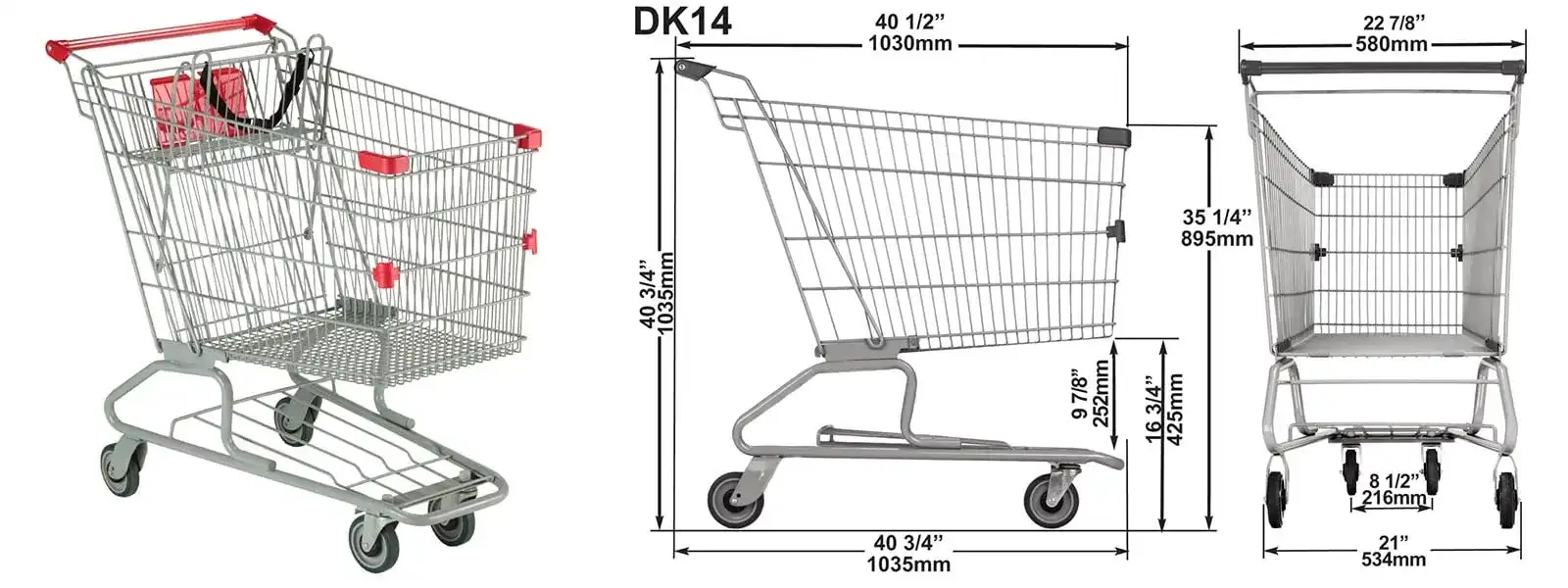
Pricing for shopping carts fluctuates considerably according to design variations, construction materials, dimensions, and integrated functionalities.
- Standard Metal Carts: Ranging from $100 to $250 each, these robust options provide reliable performance for everyday applications in mid-scale grocery outlets, featuring welded frames that withstand frequent handling.
- Plastic Carts: Priced between $80 and $200 per piece, they offer portability and resistance to environmental damage, making them a smart pick for compact venues or areas prone to humidity and salt exposure.
- Specialized Carts: From $150 up to $500 individually, encompassing innovative variants like rolling enclosures, freight haulers, or family-focused units with ergonomic add-ons that elevate usability.
- Bulk Pricing: For orders exceeding 50 units, discounts of 10% to 20% often apply, dropping base models to around $70 apiece, which proves advantageous for scaling operations.
While these figures cover initial investments, savvy owners factor in ongoing outlays for servicing and fixes to calculate true ownership costs. Reach out to our dedicated sales specialists for bespoke pricing on volume deals or personalization requests.
Types Of Supermarket Shopping Carts
Retail spaces vary widely in scale and shopper profiles, necessitating adaptable cart solutions that align with traffic patterns and space constraints. We break down four staple varieties below, highlighting their key attributes, pricing estimates, and practical applications to aid your evaluation.
Roller Basket
These nimble, basket-style units on casters excel in confined or fast-paced environments, perfect for brief errands or boutique-style grocers. At $50 to $120 apiece, construction from molded polymers or slim alloys keeps them affordable and easy to store. Their agile handling shines in tight urban layouts, promoting fluid movement and alleviating bottlenecks during peak hours. In bustling locales, deploying these can significantly improve throughput, as evidenced by reports from high-volume independents showing up to 15% faster checkout cycles.
Cargo Cart
Built for demanding loads in expansive warehouse-style markets or supercenters, cargo carts handle substantial volumes with ease. Commanding $200 to $400 per unit, they boast fortified builds capable of supporting up to 500 pounds, ideal for commercial clients or households stocking up extensively. Longevity is a hallmark here, with reinforced components minimizing downtime, though periodic caster updates may be necessary in abrasive conditions. For operators targeting value-driven bulk sales, these represent a worthwhile investment that pays dividends through extended service life.
Child Cart

Basket Cart
Offering a balanced profile, basket carts feature an elevated basket paired with a base platform, suiting versatile mid-tier establishments. Priced at $100 to $250, their modular setup delivers generous volume without excessive footprint, easing navigation in moderate aisles. The featherweight build spares flooring from undue stress, positioning them as an economical staple for emerging networks.
How Much Does It Cost to Make A Shopping Cart
Grasping the economics of fabrication illuminates the rationale behind market rates and underscores commitments to craftsmanship. The process encompasses sourcing raw inputs, workforce allocation, integration stages, and ancillary operations, with variances tied to model intricacy:
- Materials: Structural elements from alloys or synthetics comprise 50% to 60% of the budget, equating to $30 through $100, where premium corrosion-proof variants justify the premium for superior endurance.
- Labor and Assembly: Expert craftsmanship combined with robotic aids contributes $20 to $50, scaling with design sophistication and regional wage norms.
- Features: Enhancements such as juvenile accommodations, security mechanisms, or proprietary markings tack on $10 to $100, reflecting added engineering demands.
- Overhead: Encompassing facility logistics, transport logistics, and rigorous testing protocols, this layer adds $10 to $30 per instance.
Culminating in $70 to $280 overall per unit, these benchmarks highlight opportunities for direct-sourced economies. Enterprises procuring en masse from originators sidestep intermediary premiums, securing margins that fuel reinvestment.
Maintenance and Repairing Cost of Shopping Cart
Given their exposure to relentless activity, shopping carts demand consistent care to preserve functionality and aesthetics over time. Projected yearly outlays hinge on model resilience and intensity of deployment:
- Routine Cleaning: Allocating $5 to $10 per cart covers sanitization efforts that ward off corrosion and uphold sanitary standards, often achievable via in-house protocols.
- Wheel Repairs: Budget $10 to $30 for substitutions every 12 to 24 months, addressing friction from uneven surfaces or overloads.
- Frame Repairs: Interventions like soldering or part swaps span $20 to $100, contingent on alloy integrity and damage scope.
- Anti-Theft Systems: Electronic safeguards incur $5 to $15 annually for diagnostics and firmware updates.
Scaling to a 100-unit inventory, anticipate $1,500 to $5,000 in aggregate care expenses. Prioritizing resilient alloys and scheduled inspections—such as quarterly audits—can halve these figures, as demonstrated by efficient fleets reporting 30% lower repair incidences. Our tailored upkeep programs deliver scalable support to sustain peak performance without disruption.
Which Carts Should You Purchase for Your Business?
Procuring the optimal assortment hinges on evaluating facility dimensions, patron profiles, and fiscal parameters to forge a cohesive ecosystem.
- Store Size and Layout: Compact footprints favor agile roller or basket configurations to navigate snug passages, whereas vast halls call for robust cargo variants to accommodate expansive hauls.
- Customer Needs: Venues drawing families should emphasize child-inclusive models to streamline accompanied visits and cultivate goodwill.
- Durability and ROI: Elevated initial spends on alloy-heavy builds yield prolonged utility, curtailing turnover and amortizing costs over 5+ years.
- Bulk Purchasing: Thresholds of 50 units unlock substantial rebates, while bespoke engravings or upgrades amplify promotional impact at minimal incremental cost.
- Sustainability: Opting for polymer-based or reclaimable compositions resonates with eco-aware audiences, potentially lifting brand affinity by 10-15% per consumer surveys.
FAQ
How much does a shopping cart cost?
Costs for shopping carts differ by dimensions, build quality, and extras. Entry-level alloy or polymer versions typically fall between $100 and a few hundred dollars apiece, while robust or customized editions command higher tags.
What materials are supermarket shopping carts made of?
Predominant compositions include alloys for strength and ease of restoration, or polymers for reduced mass, subdued operation, and immunity to oxidation.
Are there shopping carts with special features?
Absolutely, advanced iterations boast detachable carriers, juvenile perches, or embedded tech like scanning interfaces and autonomous payment modules, all geared toward refining the retail interaction.
Where can I buy shopping carts?
You can source products through Aceally shopping cart suppliers, simplifying the process of selecting products that align with your supermarket philosophy.
What Is The Lifespan Of A Shopping Cart?
Under standard conditions, a shopping cart endures 5 to 7 years, extending to 8 with diligent care; neglect can truncate this to merely 2 to 3 years.