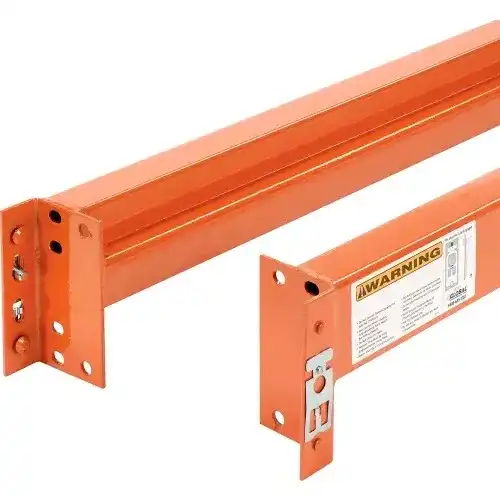


If you are choosing a pallet storage system for your warehouse, the difference between selective pallet racking and drive-in racking mainly comes down to pallet access, storage density, and inventory type.
Selective pallet racking gives you direct access to every pallet.
Drive-in racking gives you higher storage density by reducing aisle space.
If your operation handles many SKUs and frequent pallet movement, selective pallet racking is usually the better choice. If you store large volumes of the same product and want to use warehouse space more efficiently, drive-in racking is often the better fit.
✓Key Points
- Selective pallet racking is designed for direct pallet access.
- Drive-in racking is designed for high-density pallet storage.
- Selective pallet racking is better for multiple SKUs and faster picking.
- Drive-in racking is better for bulk storage and fewer SKUs.
- Selective pallet racking supports easier stock control and pallet visibility.
- Drive-in racking is commonly used in cold storage, food warehouses, and high-volume pallet storage.
- The right system depends on your warehouse layout, forklift handling, and inventory rotation method.
What Is Selective Pallet Racking?
Selective pallet racking is the most widely used pallet racking system in general warehousing. It uses upright frames and horizontal beams to create individual pallet positions, with each pallet directly accessible from the aisle.
This system is suitable when your warehouse needs flexibility, visibility, and efficient day-to-day handling. It works especially well for operations that manage many products, frequent pallet access, or changing stock profiles.
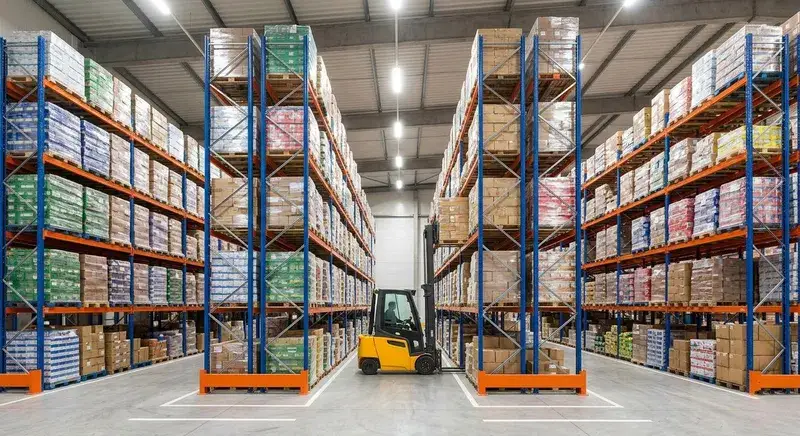
Typical Features of Selective Pallet Racking
- Direct access to every pallet
- Suitable for a wide SKU range
- Easy beam adjustment
- Compatible with standard forklift operation
- Common in distribution centers and general warehouses
If accessibility matters more than storage density, selective pallet racking is usually the practical choice.
What Is Drive-In Racking?
Drive-in racking is a high-density pallet storage system designed to reduce aisle space and increase pallet capacity. Forklifts enter the racking lanes and place pallets on side support rails.
This system is commonly used when you need to store large quantities of the same product. It is less suitable for mixed inventory, but very effective for bulk pallet storage where space efficiency is a priority.
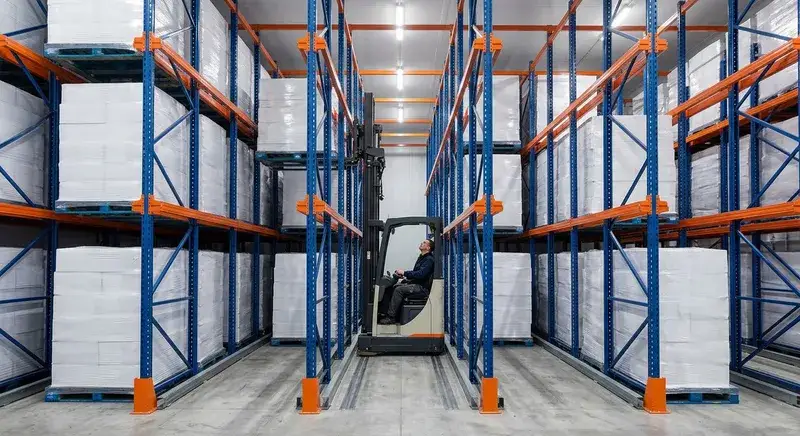
Typical Features of Drive-In Racking
- High-density storage layout
- Fewer aisles required
- Suitable for low-SKU, high-volume stock
- Typically used for LIFO inventory flow
- Common in cold rooms and bulk storage areas
If your priority is to store more pallets in the same footprint, drive-in racking is often the better option.
Selective Pallet Racking vs. Drive-In Racking
| Factor | Selective Pallet Racking | Drive-In Racking |
|---|---|---|
| Pallet access | Direct access to every pallet | Access limited by lane depth |
| Storage density | Medium | High |
| SKU suitability | High SKU variety | Low SKU variety |
| Inventory rotation | Easier for FIFO | Usually LIFO |
| Forklift movement | Standard aisle handling | Forklift enters lanes |
| Picking speed | Faster | Slower for mixed stock |
| Space utilization | Standard | Higher |
| Typical applications | General warehousing | Bulk storage, cold storage |
Specification and Purchasing Comparison
For warehouse buyers, the decision is not only about structure. It is also about how the system affects picking speed, forklift movement, inventory control, and long-term operating efficiency.
| Item | Selective Pallet Racking | Drive-In Racking |
|---|---|---|
| System Type | Standard pallet racking system | High-density pallet storage system |
| Access Method | Direct access to every pallet | Forklift enters lane to access pallets |
| Storage Density | Medium | High |
| SKU Suitability | Suitable for many SKUs | Best for few SKUs in large quantities |
| Inventory Rotation | Easier to manage FIFO | Usually LIFO |
| Pallet Selectivity | 100% pallet selectivity | Limited pallet selectivity |
| Aisle Requirement | Requires more aisles | Requires fewer aisles |
| Space Utilization | Good | Excellent |
| Forklift Requirement | Standard forklift operation | More precise forklift handling required |
| Handling Efficiency | High for mixed inventory | Better for bulk storage than fast picking |
| Picking Speed | Faster | Slower |
| Rack Impact Risk | Lower | Higher due to lane entry |
| Inventory Visibility | High | Lower |
| Installation Complexity | Relatively simple | More complex than selective pallet racking |
| Maintenance Demand | Standard inspection and maintenance | Requires closer monitoring of rails and uprights |
| Typical Warehouse Use | General warehousing, distribution, retail logistics | Cold storage, food, beverage, bulk goods |
| Best For | Operations that need accessibility and flexibility | Operations that need storage density and space savings |
| Less Suitable For | Warehouses focused on maximum storage density | Warehouses with many SKUs and frequent picking |
| Investment Focus | Operational flexibility | Space optimization |
| Common Buyer Priority | Faster access and easier stock management | Higher pallet capacity in limited space |

Key Differences Between Selective Pallet Racking and Drive-In Racking
1
Pallet Access
With selective pallet racking, every pallet can be reached directly. That makes stock handling faster and simpler, especially when orders involve different SKUs.
With drive-in racking, pallets are stored several positions deep inside the lane. Access to deeper pallets depends on the pallets stored in front.
If your warehouse needs fast access to specific pallet positions, selective pallet racking is usually more efficient.
2
Storage Density
If your priority is to maximize pallet positions in a limited area, drive-in racking has a clear advantage.
Selective pallet racking needs more aisles, which lowers storage density. Drive-in racking reduces aisle space and uses deep lane storage, which improves overall capacity.
Drive-in racking typically increases storage density by 40% to 60% compared to standard selective pallet racking.
| Storage Objective | Better Option |
|---|---|
| Direct access and flexibility | Selective Pallet Racking |
| Maximum pallet capacity | Drive-In Racking |
In high-rent or cold storage environments, this difference can directly affect warehouse cost efficiency.
3
SKU Range
Selective pallet racking is a better fit for mixed inventory and a wide SKU range. It gives you better product separation and faster access.
Drive-in racking is a better fit for a small number of SKUs stored in larger quantities.
If you handle many product lines, selective pallet racking usually supports cleaner warehouse organization and easier stock control.
4
Inventory Rotation
Selective pallet racking is easier to manage when your operation requires FIFO.
Drive-in racking is generally more suitable for LIFO inventory flow.
“According to Aceally’s structural engineering team, if your inventory rotation relies heavily on strict FIFO, selective pallet racking is the only viable choice to prevent stock obsolescence.”
5
Forklift Operation
Selective pallet racking allows forklifts to load and unload directly from the aisle, which simplifies handling.
Drive-in racking requires forklifts to enter the storage lane. This takes more precise movement and increases the need for operator control.
6
Space Utilization
Drive-in racking makes better use of warehouse cube space because fewer aisles are needed.
Selective pallet racking uses more working aisle area, but in return gives you easier access and faster pallet handling.
7
Cost Considerations
The purchase decision should include more than the rack price itself.
You should also look at:
- how much storage capacity you need
- how frequently pallets are moved
- whether your warehouse handles many SKUs
- how much aisle space is available
- how important picking speed is to your operation
Selective pallet racking is often easier to manage operationally. Drive-in racking may improve storage density, but it also requires more control in forklift handling and maintenance.
8
Safety and Maintenance
Both systems should be designed according to pallet load, forklift type, bay dimensions, and warehouse layout.
Selective pallet racking is generally easier to inspect because the structure is open and pallet positions are clearly visible.
Drive-in racking requires more attention to lane alignment, rail condition, upright protection, and possible forklift impact areas.
For buyers, this means the correct system choice is not only about capacity, but also about how the system will be used and maintained over time.
Buyer Decision
If you need a faster selection reference, the table below matches common purchasing priorities with the most suitable system.
| Buying Priority | Recommended System | Reason |
|---|---|---|
| Direct access to every pallet | Selective Pallet Racking | Each pallet position can be reached independently |
| Maximum storage capacity | Drive-In Racking | Deep lane storage reduces aisle space |
| Many SKUs | Selective Pallet Racking | Better inventory separation and faster access |
| Bulk storage of the same product | Drive-In Racking | More efficient for low-SKU, high-volume storage |
| Faster picking operation | Selective Pallet Racking | Easier forklift access from standard aisles |
| Better use of limited warehouse space | Drive-In Racking | Higher storage density |
| Easier forklift operation | Selective Pallet Racking | No need to drive into storage lanes |
| Cold storage project | Drive-In Racking | Better cube utilization in temperature-controlled space |
| Flexible inventory changes | Selective Pallet Racking | Easier to adjust to changing SKU profiles |
| Lower selectivity acceptable | Drive-In Racking | Designed for density rather than direct access |
Advantages and Limitations
Selective Pallet Racking
Advantages
- Direct access to every pallet
- Suitable for many SKUs
- Faster picking
- Easier inventory control
- Flexible for changing stock profiles
Limitations
- Lower storage density
- Requires more aisle space
Drive-In Racking
Advantages
- Higher storage density
- Better use of warehouse space
- Suitable for bulk pallet storage
- Good option for low-SKU operations
Limitations
- Reduced pallet selectivity
- Usually used for LIFO flow
- Requires more careful forklift operation
- Higher chance of rack contact
Which System Is Better for Your Warehouse?
If your operation depends on direct pallet access, mixed inventory handling, and faster picking, selective pallet racking is usually the better solution.
If your operation is focused on high-volume storage of similar products and your goal is to increase pallet capacity, drive-in racking is usually the better option.
The choice is mainly operational:
- Choose selective pallet racking for access and flexibility
- Choose drive-in racking for density and space efficiency
Typical Applications
Selective Pallet Racking Is Commonly Used For
- general warehousing
- distribution centers
- retail logistics
- e-commerce fulfillment
- mixed-SKU storage
Drive-In Racking Is Commonly Used For
- cold storage warehouses
- food and beverage warehouses
- seasonal inventory
- bulk pallet storage
- low-SKU storage operations
If you are comparing other warehouse systems as well, you may also want to review double deep racking, radio shuttle racking, or drive-through racking depending on your storage and retrieval method.
How to Choose Between Selective Pallet Racking and Drive-In Racking
Before choosing a system, review these points:
Do you need direct access to every pallet?
If yes, selective pallet racking is usually the better choice.
Do you store many SKUs or only a few?
Many SKUs usually fit selective pallet racking better. Fewer SKUs with larger pallet quantities often fit drive-in racking better.
Is your main priority access or storage density?
If access matters more, select selective pallet racking. If density matters more, select drive-in racking.
What inventory rotation method do you use?
FIFO usually aligns better with selective pallet racking. LIFO is more common with drive-in racking.
What is your forklift operating environment?
If you want simpler handling and lower lane-entry risk, selective pallet racking is generally easier to operate.
Why Partner With Aceally for Your Storage Project
As a leading pallet racking manufacturer, Aceally provides more than just equipment. We integrate advanced warehouse storage solutions into your operations. Whether you require standard selective pallet racking or high-density drive-in racking, our factory delivers precisely what you need.
Project Support & Customization
- Free CAD Design: Professional layout drawings and structural capacity calculations provided before production.
- Custom Dimensions: Customized upright heights and beam capacities manufactured to your precise structural requirements.
- OEM/ODM Supported: Custom color coatings and branding available for project contractors and importers.
Factory Capacity & Quality Packaging
- Fast Lead Time: With our automated production lines, we guarantee a standard lead time of 15-20 days for regular orders.
- Material Standards: Manufactured using high-strength Q235/Q345 steel for maximum structural integrity and safety.
- Export Packaging: All components are secured with export-standard seaworthy packaging to prevent transit damage.
Conclusion
The difference between selective pallet racking and drive-in racking is not only about rack structure. It affects your pallet access, storage capacity, forklift handling, and inventory flow.
If your warehouse needs direct access, better SKU control, and flexible operation, selective pallet racking is usually the right choice. If your warehouse needs high-density storage and fewer aisles, drive-in racking is usually the better fit.
At Aceally, we manufacture pallet racking systems for warehouse, logistics, and industrial storage projects. Our product range includes selective pallet racking, drive-in racking, and customized warehouse storage solutions based on your pallet size, load requirement, and building layout.
FAQ
What is the difference between selective pallet racking and drive-in racking?
Selective pallet racking gives direct access to every pallet, while drive-in racking increases storage density by storing pallets in deep lanes.
When should you use drive-in racking?
Drive-in racking is suitable when you store large volumes of similar products and want to reduce aisle space.
Is selective pallet racking better for many SKUs?
Yes. Selective pallet racking is usually the better choice for warehouses with many SKUs and frequent pallet access.
Does drive-in racking support FIFO?
In most cases, drive-in racking is used for LIFO rather than FIFO.
What type of racking is best for cold storage?
Drive-in racking is commonly used in cold storage because it improves storage density and reduces unused refrigerated space.
Is drive-in racking more space-efficient than selective pallet racking?
Yes. Drive-in racking is generally more space-efficient because it uses fewer aisles.
Which racking system is easier to operate?
Selective pallet racking is usually easier to operate because forklifts work from standard aisles instead of entering storage lanes.