

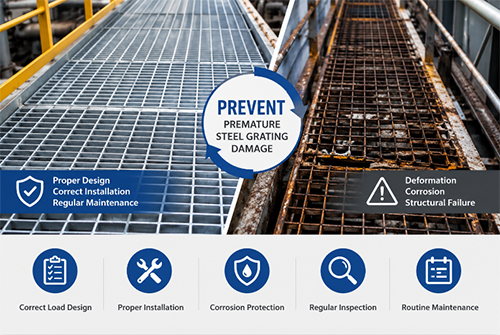
Steel grating is widely used in industrial platforms, walkways, drainage systems, wastewater treatment facilities, offshore structures, and heavy-duty maintenance areas because of its strength, drainage capability, and long service life.
Many facility owners expect galvanized steel grating to perform reliably for decades. However, premature corrosion, deformation, fatigue cracking, and structural instability are surprisingly common problems across industrial environments.
In most cases, early failure is not caused by poor steel quality alone. Instead, incorrect load calculations, insufficient corrosion protection, installation mistakes, environmental exposure, and inadequate maintenance gradually reduce the lifespan of the grating system.
The Hidden Cost of Premature Steel Grating Failure
When steel grating fails unexpectedly, the consequences often extend far beyond simple replacement costs. Damaged grating can create safety hazards, interrupt production schedules, increase maintenance expenses, and expose companies to liability risks.
| Potential Problem | Operational Impact |
|---|---|
| Localized Corrosion | Reduced structural integrity and accelerated deterioration |
| Deformed Panels | Safety risks and restricted equipment movement |
| Emergency Replacement | Higher labor and shutdown costs than planned maintenance |
| Structural Failure | Potential injury, downtime, and compliance issues |
What Causes Steel Grating to Fail Prematurely?
Although every project has unique operating conditions, most premature steel grating failures can be traced back to four root causes: incorrect structural design, inadequate corrosion protection, poor installation practices, and hidden operational stresses that develop over time.
The 4 Root Causes of Premature Steel Grating Failure
While steel grating is designed to withstand demanding industrial environments, its performance ultimately depends on correct engineering, appropriate material selection, proper installation, and routine maintenance. Understanding the most common failure mechanisms allows facility managers and engineers to prevent costly repairs before problems develop.
Incorrect Load Design and Excessive Support Span
One of the most common engineering mistakes is assuming that thicker bearing bars automatically guarantee adequate load capacity. In reality, steel grating performance depends on the relationship between load requirements, bearing bar dimensions, spacing, support span, and traffic conditions.
When support beams are spaced too far apart, the grating must bridge a larger distance than originally intended. Continuous loading then creates excessive deflection and stress concentration, eventually leading to permanent deformation.
Engineering Reality: A support span increase of only 20–30% can significantly increase bending stress and reduce the safety margin of the grating system.
Typical Warning Signs: Visible sagging, excessive deflection under foot traffic, vibration during equipment movement, and localized bending near support points.
Insufficient Corrosion Protection
Corrosion remains one of the leading causes of premature steel grating replacement. Although many products are described simply as “galvanized,” the actual zinc coating thickness and galvanizing quality can vary significantly between suppliers.
Aggressive environments accelerate corrosion considerably, especially when grating is exposed to salt, chemicals, humidity, or industrial pollutants on a continuous basis.
Best Practice: Hot-dip galvanized steel grating generally provides significantly better long-term corrosion resistance than electro-galvanized alternatives in demanding environments.
Case Example: Coastal Facility Corrosion
A coastal processing facility installed standard galvanized grating for elevated walkways located less than 500 meters from the shoreline. Within two years, corrosion became visible around cut edges and welded joints.
Subsequent inspection showed that the zinc coating specification was insufficient for continuous salt exposure. Several sections required replacement years earlier than originally projected.
The facility later upgraded to heavier hot-dip galvanized grating and implemented annual inspection schedules to improve long-term performance.
Improper Installation and Fastening
Even the highest-quality steel grating can fail prematurely when installation procedures are not followed correctly. Improper fastening, inadequate support alignment, and ignored thermal expansion requirements often create hidden stresses that become visible only after months or years of service.
❌ No expansion allowance between panels
❌ Loose or missing fixing clips
❌ Improper welding procedures
❌ Uneven support surfaces
Repeated expansion and contraction caused by temperature fluctuations can gradually distort improperly installed panels and loosen fastening systems over time.
Hidden Operational Stress and Metal Fatigue
Not all failures are immediately visible. Many structural problems develop slowly beneath the surface due to repeated loading cycles, vibration, heavy equipment traffic, and long-term fatigue accumulation.
Over time, microscopic cracks can form within welds and load-bearing components. These cracks may remain undetected until a sudden failure occurs.
- Repeated forklift or vehicle traffic
- Continuous vibration from industrial equipment
- Incorrect grating specification selection
- Heavy point loading beyond design capacity
- Long-term cyclic stress accumulation
Routine inspections are often the only reliable way to identify fatigue-related issues before they become serious structural hazards.
Steel Grating Lifespan in Different Industrial Environments
The service life of steel grating is highly dependent on environmental exposure, coating quality, load conditions, and maintenance frequency. The following estimates are based on typical industrial applications.
| Environment | Typical Service Life | Risk Level |
|---|---|---|
| Indoor Dry Industrial Areas | 30–50 years | Low |
| General Manufacturing Plants | 20–40 years | Medium |
| Coastal / Marine Areas | 15–25 years | High |
| Chemical Processing Plants | 10–20 years | Very High |
| Heavy Traffic Zones (Forklifts / Trucks) | 8–15 years | Very High |
Key International Standards for Steel Grating
Compliance with recognized international standards ensures structural safety, durability, and consistency in manufacturing and installation.
ASTM A123
Standard specification for zinc (hot-dip galvanized) coatings on iron and steel products.
ISO 1461
Hot dip galvanized coatings — specifications and test methods for steel components.
BS 4592
Industrial flooring, walkways, and stair treads safety requirements.
OSHA Standards
Regulations for walking-working surfaces and workplace safety compliance.
How to Extend Steel Grating Service Life
Preventive maintenance and correct engineering decisions significantly reduce long-term replacement costs. The following strategies are widely applied in industrial facilities to extend grating lifespan and improve safety performance.
Regular Surface Cleaning
Dirt, oil, and chemical residues accelerate localized corrosion by trapping moisture. Routine cleaning using water or neutral detergents helps preserve the protective zinc layer and prevents early coating degradation.
Quarterly Structural Inspection
Loose clips, weld fatigue, and frame misalignment are common early warning signs of structural instability. Regular inspection every 3 months helps detect issues before they escalate into safety hazards.
Protect Cut & Modified Areas
Field cutting exposes raw steel surfaces, which are highly vulnerable to oxidation. All cut edges should be immediately treated with zinc-rich paint or cold galvanizing compound to restore corrosion resistance.
Avoid Overloading and Point Loads
Excessive point loading from forklifts, heavy equipment, or improper storage layouts significantly accelerates deformation and fatigue failure in bearing bars.
Maintain Inspection Records
A structured maintenance log helps track degradation trends over time and allows predictive maintenance planning before structural failure occurs.
Frequently Asked Questions About Steel Grating Failure
The following FAQs address common concerns related to steel grating lifespan, corrosion resistance, installation, and maintenance practices in industrial environments.
How long does steel grating typically last?
Steel grating can last between 10 and 50 years depending on environmental conditions, coating quality, load intensity, and maintenance practices. Indoor dry environments offer the longest service life, while chemical and coastal environments significantly reduce durability.
What causes steel grating to rust or corrode early?
Early corrosion is usually caused by insufficient zinc coating thickness, exposure to moisture or chemicals, damaged protective layers, and lack of maintenance. Cut edges and welded joints are especially vulnerable if not properly treated.
How often should steel grating be inspected?
Industrial steel grating should be inspected at least every 3 to 6 months, depending on load conditions and environmental exposure. Heavy traffic or corrosive environments may require more frequent inspections.
What is the best protection for steel grating?
Hot-dip galvanizing (HDG) is one of the most effective protection methods for steel grating in industrial environments. It provides a thick, durable zinc layer that significantly improves corrosion resistance compared to standard coatings.