

Choosing the right pallet racking manufacturer affects more than purchase cost. It directly impacts warehouse safety, storage efficiency, lead time, installation accuracy, and long-term operating reliability. If you are comparing suppliers for a new warehouse, distribution center, or expansion project, you need to evaluate more than product photos and quotations.
In practice, the best pallet racking manufacturer is not simply the lowest-priced supplier. It is the manufacturer that can combine real production capability, reliable product quality, engineering support, stable delivery, and clear commercial communication.
✓Key Takeaways
- You should evaluate a pallet racking manufacturer based on factory capability, not price alone.
- Product quality depends on materials, surface treatment, testing, and compliance with applicable standards.
- Strong engineering support helps you avoid design errors and installation issues.
- Reliable lead time and export execution are critical for project schedules.
- Transparent quotations and after-sales service reduce long-term sourcing risk.
- A qualified manufacturer should support both standard and custom pallet racking systems.
Why Your Choice of Pallet Racking Manufacturer Matters
A pallet racking system is a structural storage solution. It carries load, defines aisle layout, affects forklift movement, and influences how efficiently your warehouse operates every day. If the design is wrong or the product quality is inconsistent, the consequences go beyond inconvenience. You may face installation delays, damaged goods, reduced storage density, or even safety hazards.
That is why professional buyers do not choose a supplier based only on a catalog or a price list. They compare manufacturers based on execution capability. If you are still early in your project planning, it also helps to review your required rack type, load capacity, and warehouse layout before you request quotations. This makes supplier comparison much more accurate.
1
Evaluate the Manufacturer’s Production Capability
The first thing you should confirm is whether you are dealing with a real manufacturer or simply a trading company. In the global warehouse storage industry, many suppliers present themselves as factories, but their actual level of control over production can vary significantly.
Does the Company Operate Its Own Factory?
A true pallet racking manufacturer should be able to show you its production workshop, forming equipment, welding area, surface treatment process, packing area, and loading process. This matters because factory ownership usually means better control over quality, scheduling, customization, and communication.
[lr_layout image=”https://www.acerackingsystem.com/wp-content/uploads/2026/03/factory-pallet-rack-1.webp” alt=”Supermarket shelving manufacturing factory”]You should ask for:
- factory photos and videos
- workshop details
- production equipment information
- company registration and export profile
- examples of previous export projects
If a supplier cannot clearly explain how and where your racks are made, that should raise concerns.
[/lr_layout]What Production Equipment and Capacity Do They Have?
For pallet racking systems, production consistency matters. Uprights, beams, braces, and accessories must be manufactured within specification. Reliable manufacturers usually have dedicated lines for roll forming, punching, welding, and powder coating.
The goal is not to collect a list of machines. The goal is to understand whether the supplier can produce consistent parts at scale. This becomes even more important if you need custom sizes, repeat orders, or phased deliveries.
Can They Handle Custom and Bulk Orders?
Standard products are common, but many warehouse projects require non-standard beam lengths, special upright heights, custom load ratings, or application-specific accessories. You should confirm whether the supplier can support:
- custom rack dimensions
- project-based quantities
- mixed container loading
- repeat orders with consistent specifications
- future warehouse expansion
If you need broader planning support, you may also want to review whether the supplier offers warehouse racking design or layout assistance, as this often separates product sellers from real project manufacturers.
| Evaluation Area | What You Should Check | Why It Matters |
|---|---|---|
| Factory Ownership | Self-operated plant, workshop proof | Better control of quality and lead time |
| Equipment | Roll forming, welding, coating lines | Stable product consistency |
| Capacity | Monthly output, project handling ability | Supports bulk and repeat orders |
| Customization | Non-standard sizes and load ratings | Fits actual warehouse requirements |
| Export Experience | Packaging, container loading, documents | Reduces execution risk |
2
Check Product Quality Standards and Certifications
Once production capability is clear, the next priority is product quality. In warehouse pallet racking, quality is not judged by appearance alone. A rack may look acceptable in photos, yet fail to meet load requirements, coating durability, or dimensional accuracy.
What Materials Are Used?
Steel quality is one of the basic factors that determine structural performance. You should ask what material grade is used for uprights and beams, whether thickness is controlled consistently, and how raw materials are sourced.
Good manufacturers can explain product specifications clearly. Vague descriptions such as “good steel” or “heavy duty quality” are not enough for a professional purchase decision.
How Is Surface Treatment Applied?
For most warehouse projects, powder coating is standard. In some environments, galvanized finishes may also be required. Surface treatment affects corrosion resistance, appearance consistency, and service life.
You should ask:
- what coating process is used
- whether pretreatment is included
- whether coating thickness is controlled
- whether the finish suits your warehouse environment
This is especially important if your facility has humidity exposure, cold storage conditions, or frequent equipment contact.
Are Load Tests and Inspections Documented?
A qualified pallet racking manufacturer should have a defined quality control process. This typically includes dimensional checks, weld inspection, coating inspection, and load-related verification. For export projects, documentation matters. You should not rely only on verbal claims.
Useful documents may include:
- inspection records
- load test reports
- material specifications
- quality control procedures
- product drawings
Which Standards or Certifications Matter?
The exact standards depend on your market. Common references may include ISO 9001 for quality management and regional compliance frameworks such as EN, FEM, RMI, or AS4084 where relevant. If you sell or install in Europe, certification and design conformity may need closer review.
The key point is simple: the supplier should know which standards apply to your market and should be able to discuss them clearly.
| Quality Factor | What to Ask | What It Tells You |
|---|---|---|
| Steel Material | Grade, thickness, consistency | Load reliability |
| Surface Finish | Powder coating or galvanized process | Durability and corrosion resistance |
| Inspection Process | In-process and final checks | Quality consistency |
| Testing | Load or structural verification | Safety confidence |
| Standards | ISO, EN, FEM, RMI, AS4084 as applicable | Market suitability |
If you want deeper insight into product quality, this is also where an internal resource such as a quality control for pallet racking page can help support your decision-making.
3
Assess Engineering and Custom Design Support
A good rack supplier can produce steel components. A strong pallet racking manufacturer can help you build the right storage system for your operation.
Can the Manufacturer Support Layout Planning?
Your rack layout affects storage density, aisle width, forklift access, and workflow. If a manufacturer understands warehouse use conditions, it should be able to discuss:
- pallet size
- forklift type
- ceiling height
- aisle configuration
- pick frequency
- future expansion needs
This is especially useful when you are planning a new warehouse or trying to increase existing storage capacity.
Do They Offer CAD Drawings or 3D Proposals?
[lr_layout image=”https://www.acerackingsystem.com/wp-content/uploads/2026/03/custom-racking-design-CAD.webp” alt=”custom racking design CAD”]Technical drawings reduce ordering mistakes. They help you confirm dimensions, level configuration, frame details, anchoring positions, and layout compatibility before production begins.
If a supplier can provide CAD drawings or 3D layouts, you are more likely to avoid problems during installation. It also shows a stronger engineering process behind the quotation.
[/lr_layout]Can They Customize the Racking System?
Not every facility uses standard pallets or standard building dimensions. In practice, customization may involve:
- rack height
- beam length
- bay depth
- load per level
- special accessories
- protection items such as guards or barriers
If you operate in sectors such as logistics, manufacturing, retail distribution, or cold storage, design flexibility becomes even more important.
Why Engineering Support Reduces Risk
Many warehouse issues begin before production. Incorrect dimensions, unrealistic aisle planning, and incomplete load assumptions often lead to rework. Design support helps prevent these problems at the planning stage.
For buyers, this is a major advantage. It allows you to compare suppliers not only as product vendors, but as technical partners.
4
Review Lead Time, Delivery Reliability, and Installation Support
Delivery performance is often underestimated during supplier selection. However, in warehouse projects, delayed production or incomplete shipments can disrupt installation schedules, labor planning, and site readiness.
Is the Lead Time Realistic?
You should ask for a clear production timeline based on order quantity, customization level, and seasonality. Extremely short promises are not always a good sign. In many cases, unrealistic lead times lead to rushed production or later delays.
A reliable warehouse racking manufacturer should explain:
- standard production cycle
- peak season impact
- custom order timing
- expected shipment window
How Are the Goods Packed and Shipped?
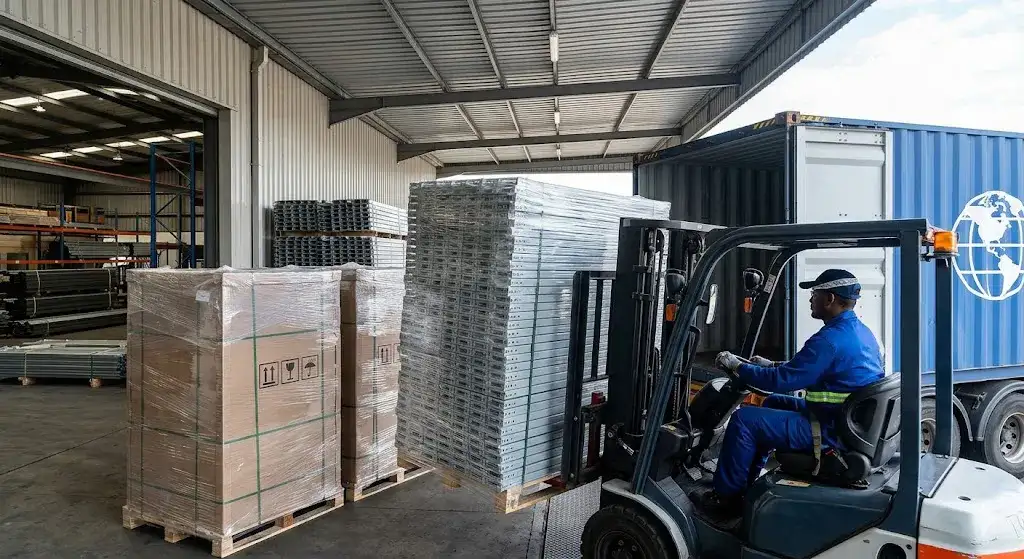
Export packaging is part of product quality. Good packing reduces transport damage, simplifies unloading, and improves installation efficiency. For international projects, it also helps if components are labeled clearly.
Look for suppliers that can explain:
- bundling method
- palletized or loose packing
- container loading approach
- part labeling
- protection of coated surfaces
Do They Provide Installation Guidance?
Even if you do not need on-site installation, technical support still matters. The supplier should be able to provide installation drawings, manuals, and guidance for your local team or contractor. This is particularly important for large pallet rack systems, where assembly accuracy directly affects safety and performance.
How Do They Handle Missing Parts or After-Shipment Issues?
You should ask what happens if there are shortages, transit damage, or urgent replacement needs. A reliable manufacturer should have a clear process, quick communication, and practical solutions.
| Delivery Factor | What You Should Confirm |
|---|---|
| Lead Time | Production timeline based on actual order scope |
| Packaging | Export-safe packing and component protection |
| Labeling | Easy identification for unloading and installation |
| Shipping Support | Document accuracy and export coordination |
| Installation | Drawings, manuals, remote technical support |
| Problem Handling | Missing parts and replacement procedure |
This part of supplier evaluation is often overlooked, but it plays a major role in total project reliability.
5
Compare Pricing Transparency and Long-Term Service
Price matters, but price alone does not tell you much. A low quotation may still become a high-cost purchase if specifications are unclear, support is limited, or product consistency is weak.
Is the Quotation Detailed and Easy to Compare?
You should be able to see clear information on:
- rack dimensions
- load capacity
- material specification
- surface treatment
- included accessories
- quantity breakdown
- terms of delivery
If a quote is too general, comparison becomes difficult and risk increases.
What Is Included in the Price?
Some suppliers quote only the main rack structure, while others include accessories, anchoring parts, protectors, design support, or packaging. You need to compare on the same basis. This is the only way to make a fair sourcing decision.
What About Warranty and After-Sales Service?
A serious manufacturer should state what support is available after delivery. This may include product replacement for verified issues, technical clarification, repeat order matching, and communication response time.
Can the Supplier Support Long-Term Cooperation?
Warehouse projects often expand over time. If your operation grows, you may need the same rack profile, dimensions, and finish again. Long-term supplier stability becomes valuable in these cases.
| Commercial Factor | Low-Visibility Supplier | Reliable Manufacturer |
|---|---|---|
| Quotation Detail | General, unclear | Structured and specific |
| Product Scope | Main parts only | Clearly defined inclusions |
| Warranty | Not clearly stated | Transparent terms |
| Repeat Orders | Inconsistent | Easier specification matching |
| Long-Term Value | Higher risk | Better lifecycle performance |
Red Flags to Watch Out for
When you compare suppliers, several warning signs usually indicate higher risk:
Unclear Load Information
If the supplier cannot clearly explain load per level, load per bay, or design assumptions, you should be cautious.
Very Low Prices with Vague Specifications
An unusually low price often means something is omitted, downgraded, or left undefined.
No Verifiable Factory Information
If the company cannot show basic factory evidence, it becomes difficult to assess actual production control.
Weak Technical Communication
Slow, unclear, or inconsistent replies usually become larger problems during project execution.
No Clear After-Sales Process
If there is no defined way to handle shortages or quality issues, your risk increases after shipment.
A Simple Buyer’s Checklist
Before you place an order, use this checklist to compare each pallet racking manufacturer more objectively:
- Do they operate their own factory?
- Can they show production capability and equipment?
- Are materials and load specifications clearly stated?
- Do they provide quality records or testing information?
- Can they support custom design and layout planning?
- Is the quotation detailed and transparent?
- Are lead times realistic?
- Can they handle export packing and documents?
- Do they provide installation guidance?
- Is after-sales service clearly explained?
If most of these answers are clear and documented, you are dealing with a much stronger supplier profile.
Frequently Asked Questions
What should you look for in a pallet racking manufacturer?
You should look for real factory capability, clear product specifications, engineering support, reliable lead time, and transparent service.
Is it better to buy directly from a pallet racking manufacturer?
In many cases, yes. Buying directly from a manufacturer usually gives you better control over customization, quality consistency, lead time, and communication.
How can you tell if a pallet racking supplier is reliable?
Ask for factory information, product drawings, testing records, export references, and a detailed quotation. Reliable suppliers can provide all of these clearly.
What certifications are important for pallet racking?
That depends on your market, but common references include ISO 9001 and compliance with regional standards such as EN, FEM, RMI, or AS4084.
How do you compare pallet racking quotes accurately?
Compare dimensions, load ratings, materials, finish, included accessories, lead time, and service scope. Do not compare price alone.
Is the cheapest pallet racking always the best option?
No. A lower initial price can lead to higher costs later through delays, missing parts, weaker quality, or poor support.
What is the difference between a pallet racking manufacturer and a trading company?
A manufacturer controls production directly, while a trading company usually sources from other factories. Direct manufacturers often offer better technical coordination and consistency.
How long does pallet racking usually take to produce?
Lead time varies by quantity, customization level, and season, but a professional manufacturer should give you a realistic production schedule before order confirmation.
Conclusion
If you want to choose the right pallet racking manufacturer, you need to look beyond the quotation. The most reliable supplier is the one that can support your project from design review to production, from quality control to delivery execution. When you assess production capability, quality standards, engineering support, lead time, and service transparency together, you reduce sourcing risk and make a stronger long-term decision.
At Aceally, we manufacture warehouse storage and racking systems with a practical focus on product consistency, technical support, and export execution. If you are comparing suppliers for an upcoming warehouse project, contact us to discuss your rack specifications, layout requirements, or custom production needs. We will help you evaluate the right solution for your operation with clear communication and factory-based support.