


In outdoor storage yards, coastal warehouses, and high-humidity industrial environments, corrosion is one of the most critical factors affecting warehouse racking lifespan.
Once rust begins to develop, it can gradually reduce structural strength, increase maintenance frequency, and shorten the overall service life of the racking system.
This is why selecting the right surface treatment—hot-dip galvanized or powder coated—directly impacts long-term operational cost and safety.
Why Corrosion Matters for Warehouse Racking
Warehouse racking systems are designed to carry heavy loads over long periods of time. However, in humid or coastal environments, steel is continuously exposed to moisture, condensation cycles, and airborne salts.
Over time, these environmental factors accelerate corrosion, which can compromise structural integrity and increase maintenance costs.
Key risk factors: humidity • temperature fluctuation • salt air • mechanical impact • poor coating protection
What Is Powder Coated Racking?
Powder coated racking is one of the most commonly used surface finishes in standard indoor warehouse systems.
The process applies electrostatically charged powder onto steel components, which is then cured under high temperature to form a protective layer.
✔ Cost-effective solution for indoor warehouses
✔ Smooth and uniform appearance
✔ Flexible color customization
✔ Widely used in retail and distribution centers
Limitations of Powder Coating in Humid Conditions
While powder coating performs well in dry environments, long-term exposure to moisture, UV radiation, and mechanical impact can gradually weaken its protective performance.
Once the coating is scratched or chipped, exposed steel becomes vulnerable to oxidation, especially in coastal or high-humidity regions.
Typical issues: coating peeling • edge corrosion • forklift impact damage • moisture penetration
How Hot-Dip Galvanized Racking Works
Hot-dip galvanizing is a metallurgical corrosion protection process in which fabricated steel components are fully immersed into molten zinc at high temperature.
During this process, a series of zinc-iron alloy layers are formed on the steel surface, creating a tightly bonded protective coating that becomes part of the steel itself rather than a simple surface layer.
This structure provides both barrier protection and sacrificial protection. Even if the surface is scratched, surrounding zinc continues to protect exposed steel and slows down corrosion development.
ENGINEERING NOTE:
Zinc layer continues electrochemical protection even after surface damage occurs.
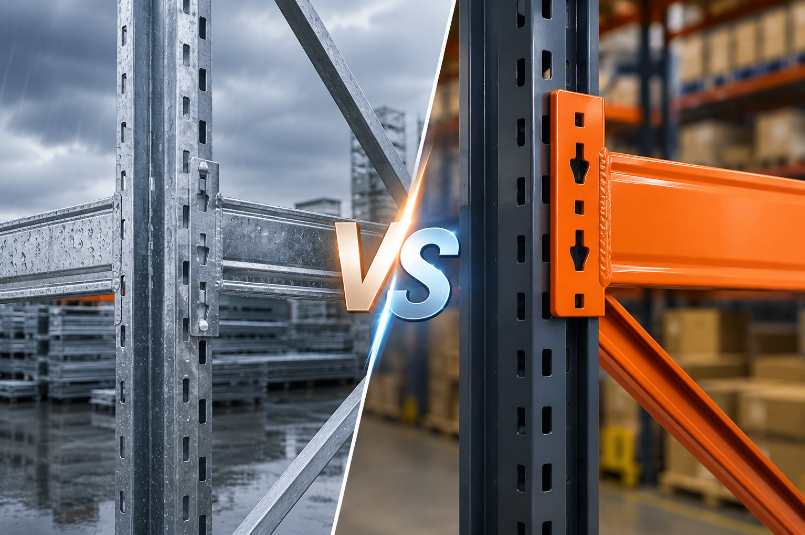
Hot-Dip Galvanized vs Powder Coated Racking
| Technical Factor | Hot-Dip Galvanized | Powder Coated |
|---|---|---|
| Surface Process | Molten zinc immersion (metallurgical bond) | Electrostatic powder spraying + curing |
| Corrosion Resistance | Excellent (industrial-grade protection) | Moderate (depends on coating integrity) |
| Suitable Environment | Outdoor / coastal / humid / cold storage | Indoor dry warehouses only |
| Service Life | 10–15+ years | 5–10 years |
INDUSTRIAL INSIGHT: In high-humidity environments, surface integrity is more important than initial purchase price.
Best Applications for Each Surface Treatment
Powder Coated Racking (Indoor Applications)
Designed for controlled environments where humidity and corrosion risk are limited.
✔ E-commerce fulfillment warehouses
✔ Manufacturing plants
✔ General indoor storage facilities
Hot-Dip Galvanized Racking (Harsh Environments)
Engineered for environments with high humidity, salt exposure, or outdoor installation requirements.
✔ Coastal warehouses
✔ Cold storage facilities
✔ Food & beverage logistics
✔ Chemical & industrial plants
Which Option Offers Better Long-Term Value?
While powder coated racking generally has a lower initial investment, its maintenance requirements may increase in humid or outdoor environments.
Hot-dip galvanized racking typically requires a higher upfront cost, but offers significantly reduced maintenance needs and longer service life under harsh conditions.
KEY INSIGHT: In high-humidity warehouses, total cost of ownership is more important than initial purchase price.
Frequently Asked Questions
Is hot-dip galvanized racking suitable for outdoor use?
Yes. It is specifically engineered for outdoor environments, including rain exposure, humidity, and coastal air conditions.
How long does galvanized racking last?
Service life typically ranges from 10 to 15+ years depending on environmental conditions, coating thickness, and maintenance level.
Can powder coated racking be used outdoors?
It can be used in limited outdoor applications, but long-term exposure to moisture may significantly reduce its lifespan compared to galvanized systems.
Which option is more cost-effective?
Powder coated racking has a lower upfront cost, while hot-dip galvanized racking often delivers better long-term value in harsh environments.
Need a Durable Racking Solution for Your Warehouse?
Every warehouse environment is different. The right surface treatment depends on your humidity level, storage conditions, and long-term operational goals.
Aceally provides both hot-dip galvanized and powder coated racking systems with customized engineering support for industrial projects worldwide.


