

High-density storage systems like drive-in pallet racking and drive-Through racking are powerful solutions, but choosing between them is critical. Picking the wrong one can mean wasted space, slower operations, higher costs, or even safety risks.
This guide cuts through the confusion. We’ll break down the key structural differences, operational impacts (LIFO vs. FIFO), cost implications, and safety considerations. By the end, you’ll have a clear framework to decide whether drive-in pallet racking or drive-Through racking is the optimal fit for your workflow.
Understanding the High-Density Racking
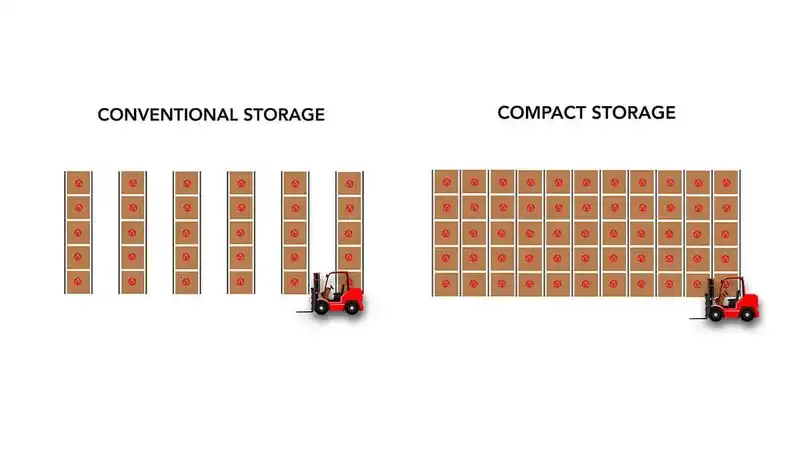
Selective pallet racking offers great accessibility but wastes significant floor space on wide aisles for forklifts to maneuver. When you need to store large quantities of fewer SKUs, high-density systems become essential.
Drive-in pallet racking and drive-Through racking are two of the most common choices, both utilizing depth instead of width to pack in more pallets. The core question isn’t just about density; it’s about how your inventory flows and how quickly you need to access it.
Drive-In Pallet Racking: Maximizing Depth for LIFO Storage
Core Structure & Design
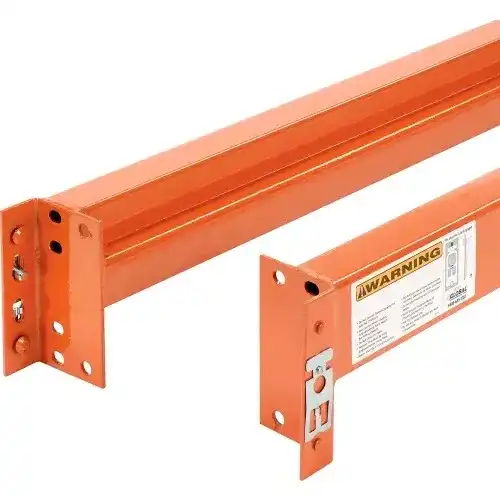
Drive-in pallet racking features a single entry point per aisle. Instead of horizontal beams supporting each pallet level, it uses continuous rails running the length of the lane. Pallets rest directly on these rails.
Crucially, a strong backstop or end frame is installed at the very rear of each lane to prevent pallets from being pushed right through. Each lane is a dedicated storage channel.
How It Works: The LIFO Principle in Action
- Loading: A specialized narrow-aisle (VNA) forklift drives into the lane from the single access point.
- Placing: The driver places the first pallet onto the rails, pushing it all the way back against the backstop.
- Stacking Depth: Subsequent pallets of the same SKU are placed directly in front of the previous one, filling the lane from back to front.
- Unloading (LIFO – Last-In, First-Out): To retrieve a pallet, the forklift enters the lane and removes the last pallet that was put in (the one closest to the entrance). Accessing a pallet deeper in the lane requires removing all pallets in front of it first.
Key Advantages of Drive-In Racking
- Storage Density: This is its superpower. By eliminating multiple aisles and utilizing depth, drive-in pallet racking offers the highest possible number of pallet positions per square foot of any rack-supported system.
- Lower Cost Pallet: Generally requires less structural framing material than drive-Through (no need for complex entry/exit structures at both ends), making it a more cost-effective solution per stored pallet upfront.
- Efficiency for Homogeneous, Slow-Moving SKUs: Perfect for storing large quantities of identical products with low turnover rates.
Limitations & Challenges
- LIFO Inventory Restriction: This is the biggest drawback. It’s Last-In, First-Out access makes it unsuitable for perishable goods, items with strict expiration dates (FIFO required), or batch control where specific pallets need direct access.
- Reduced Accessibility & Slower Throughput: Retrieving a specific pallet buried deep in a lane is time-consuming and labor-intensive (requires removing blocking pallets). This slows down order picking and overall warehouse throughput.
- Higher Forklift Operator Skill & Risk: Maneuvering deep into narrow lanes requires highly skilled VNA operators. The risk of accidentally damaging the rack structure (rails, uprights) or pallets is significantly higher than in selective racking or even drive-Through.
- Potential for Lane Blockage: If a pallet is damaged or misplaced within the lane, it can block access to the entire lane behind it.
Drive-Through Pallet Racking: Enabling FIFO Flow
Core Structure & Design
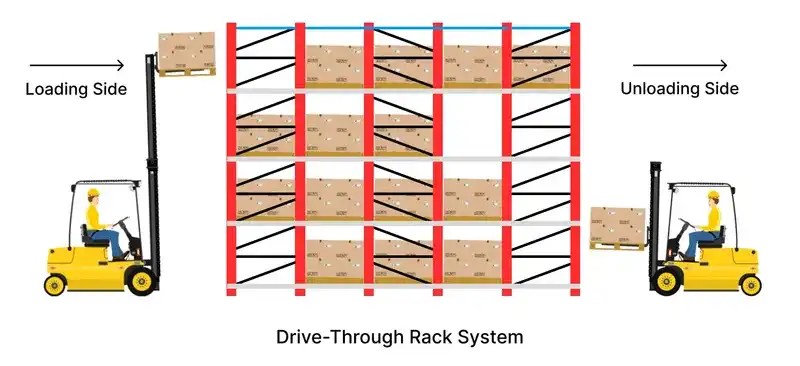
Drive-Through racking looks similar to drive-in, using rails instead of beams. The critical difference is access: it has entry and exit points at both ends of each lane. There is no backstop or end frame within the lane itself. The lane is a clear tunnel running from one end of the racking block to the other.
How It Works: The FIFO Principle Enabled
- Loading (One End): Pallets are loaded into the lane from one designated end (e.g., the “receiving” end).
- Flow: Pallets rest on the rails, pushed further into the lane as new pallets are added behind them.
- Unloading (Opposite End – FIFO): Pallets are retrieved from the opposite end of the lane (e.g., the “shipping” end). The first pallet loaded (the one deepest in the lane) is the first one retrieved – First-In, First-Out (FIFO).
- Forklift Path: The forklift drives through the lane to place or retrieve pallets near the loading/unloading points, but doesn’t necessarily need to traverse the entire length for every operation.
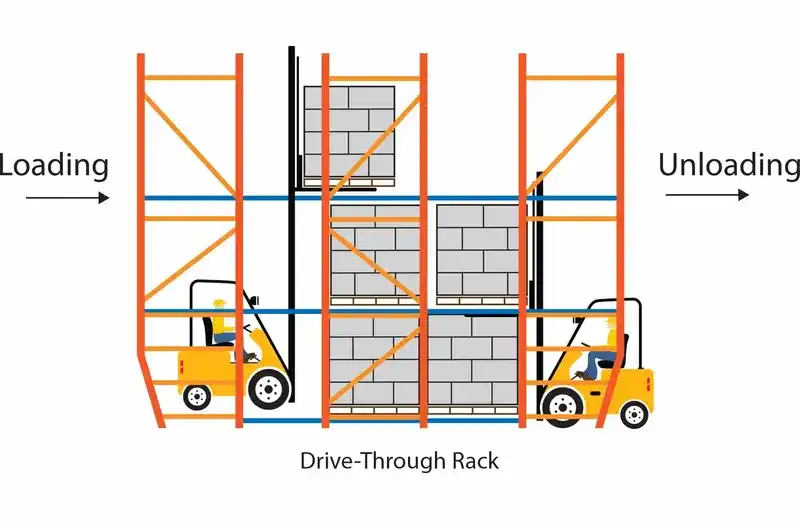
Key Advantages of Drive-Through Racking
- Faster Potential Throughput: Loading and unloading happen at opposite ends, allowing simultaneous activity and potentially faster movement of goods compared to drive-in, especially for full-pallet in/full-pallet out operations.
- Improved Accessibility: While not as direct as selective racking, access is better than drive-in because pallets are retrieved from the opposite end, eliminating the need to remove blocking pallets for specific stock.
- Reduced Lane Blockage Risk: The open ends and FIFO flow make it less likely for a single pallet to completely block a lane long-term.
Limitations & Challenges
- Lower Storage Density than Drive-In: Requires clear aisle space at both ends of the lane for forklift access. This reduces the total number of pallet positions per square foot compared to drive-in pallet racking.
- Higher Initial Cost: The structure is more complex, requiring robust entry/exit frames at both ends. This typically results in a higher cost per pallet position than drive-in systems.
- Requires Disciplined Workflow: Strict adherence to FIFO loading/unloading from the correct ends is crucial. Mixing up ends disrupts the entire system.
- Still Requires VNA Forklifts: Like drive-in, it needs specialized narrow-aisle equipment and skilled operators.
Comparison: Drive-In vs. Drive-Through Racking
| Feature | Drive-In Pallet Racking | Drive-Through Pallet Racking |
|---|---|---|
| Access Points | Single Entry Point Only | Entry AND Exit Points |
| Inventory Method | LIFO (Last-In, First-Out) | FIFO (First-In, First-Out) |
| Storage Density | Highest (Pallets/Sq.Ft) | High (But Lower Than Drive-In) |
| Throughput Speed | Slower (Due to LIFO access) | Faster (Dedicated In/Out) |
| Ideal SKU Profile | Homogeneous, Slow-Moving | Perishable, Dated, Batch Control, Faster-Moving |
| Initial Cost (Per Pallet Pos) | Lower | Higher |
| Forklift Skill | Higher (Precise deep maneuvering) | Moderate** (Entry/Exit focus) |
| Risk of Rack Damage | Higher | Moderate |
| Warehouse Layout | Needs strong rear wall/anchor | Needs clear space at BOTH ends |
| Best For | Max space savings, non-perishable bulk | FIFO compliance, better flow |
How to Choose the Right System
Ask these critical questions:
What is Your Inventory Profile?
- Perishable or Dated? (FIFO Mandatory): → Drive-Through Pallet Racking is likely essential.
- Strict Batch Control Needed? (FIFO Preferred): → Drive-Through Pallet Racking is strongly recommended.
- Homogeneous, Slow-Moving, Non-Perishable? (LIFO Acceptable): → Drive-In becomes a viable, high-density option.
- High SKU Variety?: Neither is ideal; consider selective or push-back racking.
What Are Your Operational Needs?
- High Throughput Required?: Drive-Through Pallet Racking generally allows faster pallet movement due to separate in/out points.
- Primarily Full-Pallet In/Full-Pallet Out?: Both can work, but Drive-Through Pallet Racking edges out for speed if FIFO is needed.
- Need Frequent Access to Specific Pallets?: Neither excels, but Drive-Through Pallet Racking offers better accessibility than Drive-In Pallet Racking. If critical, consider selective racking.
What Does Your Warehouse Space & Layout Allow?
- Extreme Space Constraint?: Drive-In Pallet Racking offers the absolute highest density.
- Can You Dedicate Clear Space at Both Ends of Lanes?: Mandatory for Drive-Through racking .
- Suitable Rear Wall/Anchor Point Available?: Needed for Drive-In Pallet Racking backstops.
- Aisle Width/Ceiling Height: Both require VNA forklifts and compatible dimensions.
What is Your Budget Reality?
- Prioritize Lowest Upfront Cost per Pallet?: Drive-In Racking usually wins.
- Willing to Invest More for FIFO/Flow?: Drive-Through Racking justifies its higher cost for the right inventory.
- Consider Total Cost of Ownership (TCO): Factor in potential damage repair (higher risk with Drive-In Racking).
When Neither Drive-In racking Nor Drive-Through racking is Ideal
High-density needs vary. Consider these alternatives:
- Push Back Racking: Offers some density gain (2-6 deep) with limited selectivity within the depth. Can be configured for LIFO or FIFO. Good medium-density option.
- Pallet Flow Racking: Highest-density FIFO system using gravity rollers. Higher cost but excellent for fast-moving FIFO goods. Requires significant slope.
- Mobile Pallet Racking (Mobile Aisles): Extremely high density (only one moving aisle), but high cost and slower access. Good for archives or very low-turnover stock.
- Selective Pallet Racking: Still the king for accessibility and flexibility, but lowest density. Use where SKU variety is high and direct access is critical.
Conclusion
Choosing between drive-in pallet racking and Drive-Through racking racking isn’t about finding a “best” system; it’s about finding the best system for your specific operational reality.
The core differentiator boils down to inventory flow: Drive-In pallet racking delivers maximum density for LIFO-compatible goods, while Drive-Through racking enables essential FIFO flow at a slight density cost.
It’s drive-in pallet racking, Drive-Through racking, or another alternative – that truly optimizes your space, cost, and operational efficiency.