

Selecting the right wire mesh container requires more than comparing prices. The ideal steel wire container should match your load requirements, warehouse layout, handling equipment, stacking conditions, and purchasing volume.
A properly selected wire mesh container can improve storage efficiency, simplify material handling, and reduce long-term operating costs. Before placing an order, it is important to evaluate the container structure, load capacity, dimensions, and compatibility with your existing warehouse system.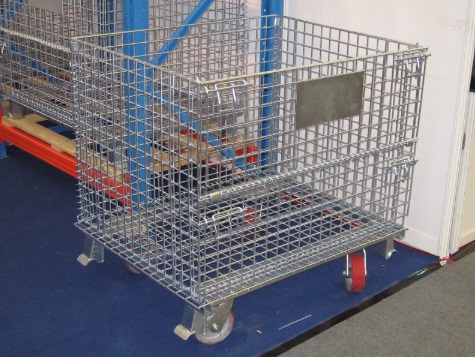
1. Start with the Load Requirements
The first step is to understand what you will store inside the container. Different materials require different wire diameters, mesh openings, and structural designs.
| Storage Requirement | Recommended Choice |
|---|---|
| Heavy metal parts, castings, or bars | 5.0–6.0 mm wire with reinforced frame structure |
| General industrial components | 4.0–5.0 mm wire with standard mesh opening |
| Small components and fasteners | Smaller mesh openings such as 25×25 mm |
| Oily or wet components | Larger mesh openings for improved drainage |
Important:
Wire diameter is only one factor affecting strength. The frame tube size, base reinforcement, welding quality, and overall container design also influence the actual load capacity.
Surface Treatment Considerations
For humid, outdoor, or coastal environments, hot-dip galvanizing generally provides better corrosion protection
than standard powder coating. For food, pharmaceutical, or cleanroom applications, the material and surface treatment should be selected according to the required hygiene standards.
2. Check Dimensions Before Ordering
Do not assume that a “standard” size will fit your warehouse. The correct wire mesh container dimensions should match your pallets, storage racks, forklifts, and available warehouse space.
Common Wire Mesh Container Footprints
800 × 600 mm
Compact industrial storage size
1000 × 800 mm
Common warehouse container size
1200 × 1000 mm
Suitable for larger industrial loads
Key Dimensions to Confirm
Container Footprint
Make sure the external dimensions fit your storage area, rack system,
and transportation requirements.
Fork Access
Check fork opening dimensions and fork spacing according to your actual forklift
or pallet jack specifications.
Container Height
Ensure the loaded container can be safely lifted and placed at the intended storage height.
Rack Compatibility
Confirm beam spacing, support points, and allowable container dimensions before using
containers on pallet racking systems.
Aisle Width
Consider the turning radius of a loaded forklift instead of looking only at container size.
Warehouse Compatibility Check
Before purchasing bulk quantities, verify the container dimensions together with your forklift specifications, rack layout, and material handling process. A correctly sized wire container improves warehouse safety and operational efficiency.
3. Confirm Load Capacity and Stacking Requirements
Never judge a wire mesh container only by a single “maximum load” number. Different working conditions require different load ratings.
Static Load
The maximum weight the container can support while standing on a level floor.
Dynamic Load
The allowable load when the container is transported by forklift or pallet jack.
Racking Load
The capacity when the container is supported by rack beams.
Important Safety Consideration
Static, dynamic, and racking load capacities can be different. Always verify the required capacity according to the actual operating conditions.
Stacking Requirements
For stacking applications, confirm the maximum number of loaded layers before purchase. The safe stacking height depends on:
- Corner post strength
- Locking structure
- Base reinforcement
- Load distribution
- Overall container design
Rigid wire containers are commonly designed for multi-layer stacking, while collapsible wire containers may have different stacking limitations depending on their folding mechanism and locking system. Containers equipped with castors are generally not suitable for high stacking.
4. Choose the Right Handling Method
Wire mesh containers can be moved by different handling equipment depending on the design. Before ordering, make sure the container structure matches your warehouse handling process.
Forklift
Common handling method for warehouse operations.
Pallet Jack
Suitable for short-distance internal movement.
Crane Equipment
Only when the container is specifically designed with lifting points.
Castors
Used for short-distance manual movement.
Confirm Before Ordering
- Fork pockets
- Reinforced feet
- Lifting points
- Locking mechanisms
A wire container designed for forklift handling should not automatically be considered suitable for crane lifting. Additional reinforcement and testing may be required.
5. What to Confirm for Bulk Orders
Before placing a large order, request a complete specification sheet covering the following details:
01. Dimensions
Overall dimensions and manufacturing tolerances.
02. Wire Structure
Wire diameter, mesh opening size, and frame specifications.
03. Load Rating
Static, dynamic, and racking load capacities.
04. Stacking Capacity
Maximum stacking height and loaded layer limitation.
05. Surface Treatment
Coating type, galvanizing option, and surface protection requirements.
06. Logistics Information
Packaging method, container loading quantity, and shipping efficiency.
07. Testing Options
Sample availability or load testing before mass production.
08. Production Terms
Lead time, warranty terms, and after-sales support.
Consider Total Purchasing Cost
For bulk purchases, calculate the cost per usable unit, not only the factory price.
Packaging efficiency, container loading quantity, shipping costs, customs fees,
and replacement expenses can significantly affect the final purchasing cost.
Key Points Before Buying Wire Mesh Containers
The best wire mesh container is not necessarily the cheapest or the heaviest one.
The right choice should balance:
Storage Requirements
Load Capacity
Handling Equipment
Rack Compatibility
Warehouse Conditions
Long-Term Cost Efficiency
Selecting the right steel wire container ensures safer handling, better warehouse utilization, and more efficient material management.
Need Wire Mesh Containers for Industrial Storage?
For bulk orders, manufacturers can provide customized dimensions, load testing, surface treatment options, and solutions based on your warehouse requirements.