

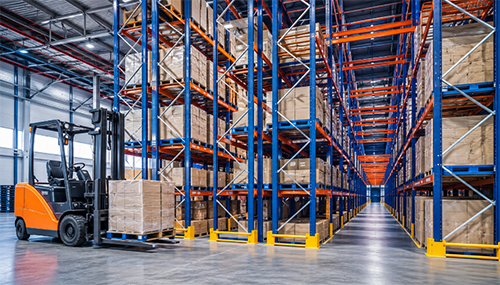
Drive-in racking system is a high-density storage solution designed for warehouses that require maximum pallet capacity within limited floor space. Unlike selective racking, forklifts travel directly inside storage lanes, enabling compact storage with minimal aisle space.
In real warehouse engineering practice, drive-in systems are not only about increasing storage density—they require careful structural design, forklift compatibility, load calculation, and fire safety coordination.
This technical guide explains the most critical design and operational risks based on real warehouse engineering experience, helping buyers and warehouse planners avoid costly structural and operational failures.
1. Load Distribution Failure in Drive-in Racking Design
One of the most common engineering issues in drive-in racking design is misunderstanding how loads are transferred through the structure.
These systems are engineered based on uniformly distributed load (UDL), meaning pallet weight must be evenly distributed across beams and uprights.
Engineering parameters (typical design range):
- Beam load capacity: 1500–3000 kg per level
- Bay load capacity: 6000–12000 kg per structural bay
When pallets are placed unevenly, a point load effect occurs, creating localized stress concentration. Over time, this can lead to deformation of beams, upright fatigue, and reduced system lifespan.
2. Forklift Compatibility and Lane Geometry Mismatch
Drive-in racking systems rely heavily on forklift operation accuracy. Any mismatch between forklift specifications and lane design directly impacts safety and efficiency.
Key design compatibility factors:
- Forklift turning radius
- Mast height and lifting clearance
- Lane width (typically 2400–2700 mm)
- Operator visibility inside deep lanes
If forklift dimensions are not properly matched with rack geometry, the system will experience increased collision risk, slower cycle times, and higher maintenance costs.
3. Excessive Lane Depth and Operational Inefficiency
While increasing lane depth improves theoretical storage density, it often reduces operational efficiency in real warehouse environments.
Recommended design range:
5–7 pallet positions per lane (balanced efficiency and safety)
Excessively deep lanes reduce visibility, increase forklift reverse distance, and make FIFO/FILO control more difficult, especially in cold storage and FMCG warehouses.
4. Fire Safety and Sprinkler System Integration Risks
Because drive-in racking creates high-density storage blocks, fire protection design becomes a critical engineering requirement rather than an optional feature.
- Sprinkler penetration must reach internal lane depth
- Open structural spacing is required for airflow
- Wire mesh decking may be required depending on local code
Poor fire system integration can result in insufficient suppression coverage in deep lanes, significantly increasing warehouse risk exposure.
5. Material Specification and Structural Durability Issues
Material selection directly affects the long-term performance of drive-in racking systems.
- Steel thickness below engineering standard (< 2.0 mm increases deformation risk)
- Weak welding at beam-connector joints
- Insufficient surface treatment causing corrosion in humid environments
These issues reduce structural lifespan and increase long-term maintenance costs.
6. Installation Accuracy and Maintenance Neglect
Even a correctly designed system can fail if installation precision is poor.
- Improper anchoring of uprights
- Misaligned guide rails
- Loose beam locking systems
Routine maintenance is recommended every 3 months to ensure structural stability and prevent cumulative deformation.
7. Lack of Future Expansion Planning
Many warehouses design drive-in systems only for current storage demand without considering future scalability.
- Non-modular lane structures
- Limited bay expansion options
- High cost of redesign during business growth
A scalable design should always consider future pallet growth and modular expansion capability.
Engineering Insight (Real Warehouse Practice)
In high-density cold storage projects, improper lane depth and forklift mismatch are the two most common causes of system inefficiency. Proper engineering evaluation before installation can improve storage utilization by up to 30% while reducing maintenance incidents.
Conclusion
Drive-in racking is a highly efficient storage system, but its performance depends on engineering accuracy, forklift compatibility, fire safety integration, and proper maintenance planning.
A well-designed system balances storage density, operational efficiency, and long-term structural safety rather than maximizing space alone.