


If you are running a mid-sized business, you know that inventory isn’t just “stuff” sitting in a warehouse,it is cash tied up in boxes. How you account for that stock determines how much profit you show to the world and, more importantly, how much tax you pay to the government.
This brings us to one of the most critical decisions in accounting: choosing between LIFO (Last-In, First-Out) and FIFO (First-In, First-Out).
While these acronyms might sound like accounting jargon, they are actually powerful levers for your financial strategy. The method you choose directly impacts your balance sheet, your net income, and your tax liability.
Let’s dive deep into the mechanics of these inventory valuation methods, use real-world examples to break down the math, and help you figure out which approach aligns with your business goals.
Understanding the Core
Before we jump into the battle of LIFO vs. FIFO, we need to set the stage. Why does this matter?
When you sell a product, you incur a cost. This is known as the Cost of Goods Sold (COGS). The formula for profit is simple:
Revenue – COGS = Gross Profit
The problem is that the cost of purchasing inventory rarely stays the same. The raw materials you bought in January likely cost less than the ones you bought in December due to inflation. So, when you sell a finished product today, which cost do you use? The cheap January price or the expensive December price?
Your answer changes your COGS. And as you can see from the formula above, if you change your COGS, you change your Profit. This is where LIFO and FIFO come into play.
What Is FIFO (First-In, First-Out)?
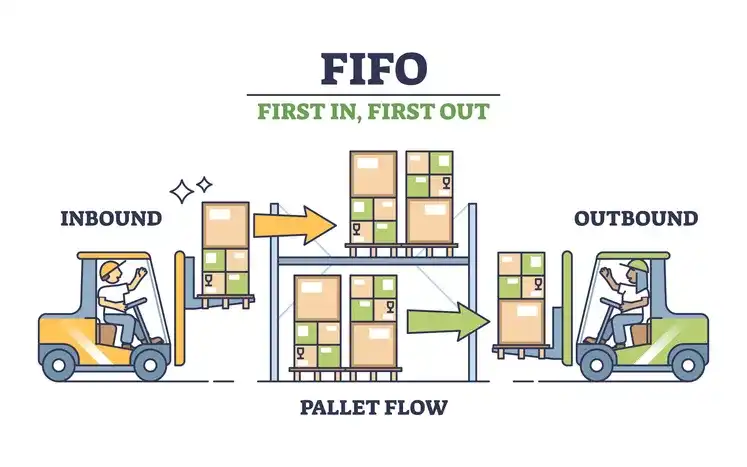
First-In, First-Out (FIFO) is exactly what it sounds like. Under this method, you assume that the inventory items you purchased first are the first ones to be sold.
Imagine a bakery. When you bake fresh bread, you want to sell the oldest loaves first before they go stale. You put the new bread at the back and push the older bread to the front. FIFO accounting mimics this physical flow.
Because prices generally rise over time (inflation), your “oldest” inventory is usually your cheapest.
- COGS: Since you are “selling” the older, cheaper items first, your Cost of Goods Sold is lower.
- Profit: A lower COGS means a higher Gross Profit.
- Inventory Value: The remaining inventory on your shelves is valued at the newer, higher prices. This means your balance sheet reflects the current market value of your assets.
What Is LIFO (Last-In, First-Out)?
Last-In, First-Out (LIFO). This method assumes that the items you purchased most recently are the first ones to be sold.
Think of a hardware store with a bin of nails. When you restock, you pour new nails on top of the old ones. When a customer buys nails, they scoop from the top,taking the newest stock first. The old nails stay at the bottom.
In an inflationary economy, your most recent purchases are usually the most expensive.
- COGS: Since you are “selling” the newer, pricier items first, your Cost of Goods Sold is higher.
- Profit: A higher COGS means a lower Gross Profit.
- Inventory Value: The remaining inventory on your books is valued at the older, cheaper prices. This can sometimes result in a balance sheet that undervalues your assets compared to current market rates.

LIFO vs. FIFO
To truly understand the difference, we need to look at the numbers.
Imagine you run a wholesale bakery. Over the course of a week, you produce three batches of bread. Due to rising flour prices, the cost to produce each batch goes up slightly.

Your Production Schedule:
| Batch Name | Quantity Produced | Cost Per Unit | Total Cost |
|---|---|---|---|
| Batch 1 (Monday) | 2,000 Loaves | \$1.00 | \$2,000 |
| Batch 2 (Wednesday) | 2,000 Loaves | \$1.10 | \$2,200 |
| Batch 3 (Friday) | 2,000 Loaves | \$1.15 | \$2,300 |
| Totals | 6,000 Loaves | \$6,500 |
The Sales Scenario: By the end of the week, you have sold 4,000 loaves of bread at a retail price of \$1.50 each. Total Revenue: 4,000 x \$1.50 = \$6,000.
Now, we need to calculate the profit. But to get the profit, we must calculate the COGS for those 4,000 loaves.
Scenario A: Calculating with FIFO
Under FIFO, you assume the 4,000 loaves sold came from the oldest batches first (Batch 1 and Batch 2).
- Sell Batch 1: 2,000 loaves @ \$1.00 = \$2,000
- Sell Batch 2: 2,000 loaves @ \$1.10 = \$2,200
- Total COGS: \$2,000 + \$2,200 = \$4,200
FIFO Profit Calculation:
- Revenue: \$6,000
- Minus COGS: \$4,200
- Net Profit: \$1,800
Scenario B: Calculating with LIFO
Under LIFO, you assume the 4,000 loaves sold came from the newest batches first (Batch 3 and Batch 2).
- Sell Batch 3: 2,000 loaves @ \$1.15 = \$2,300
- Sell Batch 2: 2,000 loaves @ \$1.10 = \$2,200
- Total COGS: \$2,300 + \$2,200 = \$4,500
LIFO Profit Calculation:
- Revenue: \$6,000
- Minus COGS: \$4,500
- Net Profit: \$1,500
The Result
By simply changing the accounting method from FIFO to LIFO, your reported profit dropped from \$1,800 to \$1,500. You didn’t sell different bread, and you didn’t change your prices—you just changed how you counted the cost.
Why Choose One Over the Other?
You might be asking, “Why would I want lower profit?” That sounds counterintuitive. However, there are strategic reasons for both methods depending on your business lifecycle.
The Case for FIFO (First-In, First-Out)
Most businesses, especially retailers and those dealing with perishable goods, default to FIFO.
1. Maximizing Reported Profit As seen in our calculation, FIFO results in a higher net income. If you are a startup looking for investors, or a mid-sized business applying for a bank loan, you want your financials to look as strong as possible. High profit indicates a healthy, growing company.
2. Accurate Balance Sheet With FIFO, the inventory left on your books (Ending Inventory) consists of the most recently purchased items. This means the asset value on your balance sheet accurately reflects what that inventory would cost to replace today.
3. International Compliance If you plan to expand your business globally, FIFO is the safer bet. The IFRS (International Financial Reporting Standards), which governs accounting in many countries outside the US, actually prohibits the use of LIFO. Using FIFO ensures you are compliant worldwide.
The Case for LIFO (Last-In, First-Out)
LIFO is predominantly used in the United States under GAAP (Generally Accepted Accounting Principles).
1. Tax Advantages This is the number one reason companies choose LIFO. Look back at our example:
- FIFO Profit: \$1,800
- LIFO Profit: \$1,500
If the corporate tax rate is 21%, you pay taxes on \$1,800 with FIFO, but only on \$1,500 with LIFO. In times of high inflation, LIFO increases your COGS, lowers your taxable income, and keeps more cash in your bank account.
2. Matching Current Costs with Revenues LIFO is often viewed as more accurate for measuring operating performance in inflationary environments. It matches your current sales revenue against the current (higher) cost of replacing that inventory, giving you a realistic view of your margins.
3. The Downside: Complex Record Keeping LIFO can be administratively difficult. Because older inventory costs can stay on the books for years (sometimes decades), tracking these “layers” of inventory requires sophisticated accounting software. Furthermore, if you ever sell off that old inventory (known as “LIFO liquidation”), you could trigger a massive, unexpected tax bill.
Other Valuation Methods mentioned
While FIFO and LIFO receive the most attention, the source material highlights that they are not your only options. Depending on your inventory type, you might consider:
Specific Identification Method
This is the most precise method. It involves tracking the actual cost of every single item in your inventory individually.
- Best for: Businesses selling high-value, unique items like cars, fine jewelry, or real estate.
- How it works: If you sell a specific red sports car, you record the exact invoice cost of that specific car. You don’t average it with the blue sedan next to it.
- Pros: 100% accuracy.
- Cons: Impossible for businesses selling thousands of identical small items (like screws or t-shirts).
Weighted Average Cost (WAC)
This is the “middle ground” solution. Instead of tracking which batch came first or last, you calculate an average cost for all units available for sale during the period.
- Formula: Total Cost of Goods Available for Sale / Total Units Available for Sale.
- Best for: Businesses with large volumes of identical items where individual tracking is tedious, like liquid fuels, chemicals, or small manufacturing parts.
- Pros: Smooths out price fluctuations and is much simpler to calculate than LIFO.
Comparison Table: LIFO vs. FIFO vs. Average Cost
| Feature | FIFO (First-In, First-Out) | LIFO (Last-In, First-Out) | Weighted Average |
|---|---|---|---|
| Assumption | Oldest items sold first. | Newest items sold first. | All items mixed together. |
| Impact on COGS (Inflation) | Lower COGS. | Higher COGS. | Average COGS. |
| Impact on Net Income | Higher Profit. | Lower Profit. | Moderate Profit. |
| Tax Liability | Higher Taxes. | Lower Taxes. | Moderate Taxes. |
| Ending Inventory Value | High (Current Market Price). | Low (Historical Price). | Average Price. |
| Complexity | Low to Medium. | High. | Low. |
| International Use | Accepted Globally (IFRS). | Banned by IFRS (US Only). | Accepted Globally. |

Choosing the Right Path for Your Business
Deciding between these methods is not just a math problem; it is a business strategy decision.
Stick with FIFO if:
- You are in retail, food service, or fashion where goods physically move in a FIFO manner.
- Your goal is to show high profits to attract investors or lenders.
- You operate internationally or plan to expand overseas.
- Inventory prices are stable or dropping (deflation).
Consider LIFO if:
- You are a US-based company.
- You are in an industry with consistently rising costs (manufacturing, petroleum, construction).
- Your primary goal is to reduce your current tax burden and improve cash flow.
- You have the accounting software capable of handling complex LIFO layers.
Important Note on Consistency: The IRS requires consistency. You cannot use LIFO for your tax return to save money and then use FIFO for your financial statements to impress investors. This is known as the LIFO Conformity Rule. Once you pick a method, you generally have to stick with it, and switching (especially from LIFO back to FIFO) can be a complicated and expensive process approved by the IRS.
Conclusion
The difference between the LIFO and FIFO method essentially boils down to timing and taxes. FIFO offers a clearer picture of your inventory’s current value and boosts your paper profits, making it ideal for growth-focused companies. LIFO, on the other hand, is a tax-minimization tool effectively used by mature companies facing rising costs.
Inventory valuation is complex, and the stakes are high. A mistake here can lead to overpaying taxes or misrepresenting your company’s health.
Don’t navigate this alone. We strongly recommend consulting with a CPA or tax professional who can model these scenarios using your actual business data. Furthermore, investing in robust inventory management software, like Aceally Pallet Racking Manufacturer, can automate these calculations for you, ensuring accuracy whether you choose LIFO, FIFO, or Weighted Average.
Ready to get your inventory under control? Start reviewing your COGS strategy today.
FAQ
Q1. Does the physical flow of goods have to match the accounting method?
No, this is a common misconception. You can physically sell your oldest milk cartons first (to prevent spoilage) but still use LIFO for your accounting records. The accounting method is a cost flow assumption, not a rule for how you physically move boxes in the warehouse.
Q2. Why is LIFO banned under IFRS?
International standards (IFRS) focus on the balance sheet’s accuracy. Since LIFO can leave inventory valued at prices from 10 or 20 years ago, regulators feel it distorts the true value of a company’s assets, making it harder for international investors to compare companies.
Q3. Can I change my inventory method later?
Yes, but it is not easy. To change your accounting method, you must file Form 3115 with the IRS. If you switch from LIFO to FIFO, you may have to pay back the taxes you “saved” in previous years, which can be a significant financial hit.
Q4. What happens if costs are going down (Deflation)?
In a deflationary environment (prices dropping), the roles reverse. FIFO would result in higher COGS and lower taxes, while LIFO would result in lower COGS and higher taxes. However, since inflation is the norm in most economies, LIFO is generally associated with tax savings.
Q5. Is Weighted Average easier than FIFO or LIFO?
Generally, yes. It requires less detailed tracking of specific batches. However, it doesn’t offer the strategic tax benefits of LIFO or the profit-maximizing appearance of FIFO. It is a neutral middle ground.