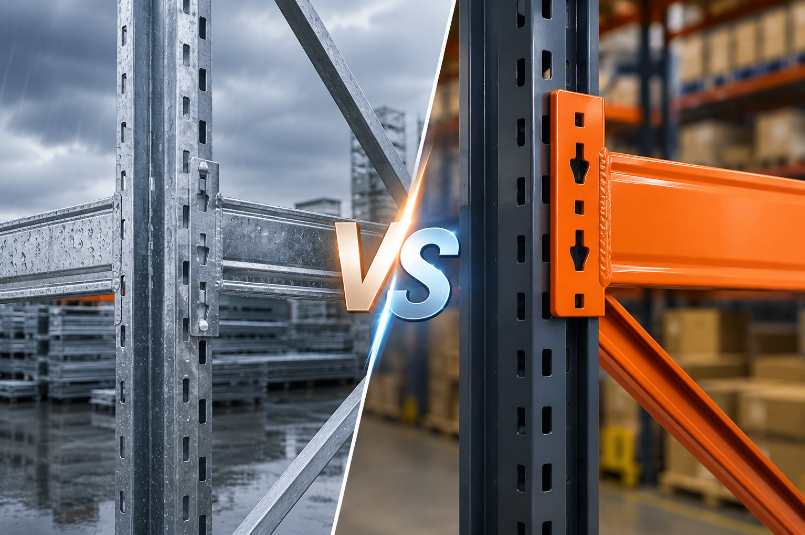


Choosing between slotted angle shelving and boltless rivet shelving is not as straightforward as comparing two similar-looking storage racks. While both belong to the category of light- to medium-duty steel shelving, they are engineered around different structural principles and are intended for different operational environments.
Many buyers focus primarily on the purchase price or advertised load capacity. In practice, however, those specifications reveal only part of the story. Several additional factors, including connection rigidity, steel thickness, load distribution, warehouse layout changes, maintenance requirements, and the expected service life of the shelving system, influence long-term performance. A rack that appears less expensive initially may require more frequent repairs or replacement if it is repeatedly relocated or subjected to demanding daily use.
For warehouse managers, distributors, workshop owners, and procurement teams, selecting the right shelving system should therefore be viewed as an investment decision rather than simply a product comparison. Understanding how each design performs under real operating conditions helps reduce maintenance costs, improve workplace safety, and extend the usable life of the storage system.
This guide compares slotted angle shelving and boltless rivet shelving from an engineering and operational perspective. Instead of focusing only on product specifications, we examine structural design, load-bearing principles, installation efficiency, durability, maintenance requirements, lifetime ownership costs, and the environments where each system performs best. Whether you are equipping a new warehouse, expanding a retail stockroom, or upgrading an industrial workshop, this comparison will help you select the shelving solution that best matches your operational requirements.
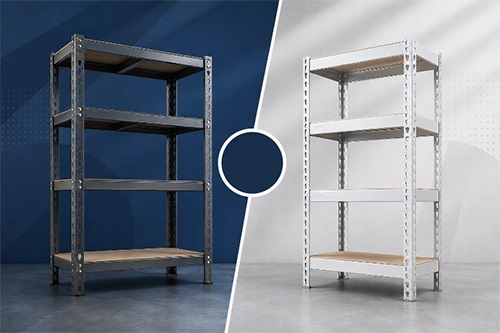
Quick Answer
If your shelving will remain in the same location for years, regularly support medium to heavy cartons, or require frequent shelf-height adjustments, slotted angle shelving is generally the better long-term investment. Its bolted frame provides greater structural rigidity, higher resistance to deformation, and better adaptability for changing storage needs.
If installation speed, low initial cost, and lightweight manual storage are your primary concerns, boltless rivet shelving offers a practical and economical alternative. Its tool-free assembly makes it well-suited for retail stockrooms, garages, archive rooms, and temporary storage applications where loads remain relatively light and layouts change frequently.
Ultimately, the better choice depends not only on load capacity but also on expected service life, maintenance frequency, warehouse expansion plans, and total ownership cost.
Why Buyers Often Choose the Wrong Shelving
One of the most common purchasing mistakes is assuming that all steel shelving performs similarly because the finished products look almost identical. In reality, two shelving systems with comparable dimensions can behave very differently once they begin carrying loads day after day.
Many purchasing decisions are based on three factors alone:
- Lowest unit price
- Maximum advertised load capacity
- Fast installation
While these criteria are important, they rarely determine the total cost of ownership over the life of the shelving.
For example, a distributor planning to reorganize warehouse layouts every year may benefit from a shelving system designed for quick assembly. Conversely, a manufacturing facility expecting continuous operation for ten years may place greater value on structural stability, repairability, and long-term durability. Selecting the wrong system can lead to unnecessary maintenance, reduced operational efficiency, or premature replacement of shelving components.
Before comparing technical specifications, buyers should first consider several practical questions:
- Will the shelving remain in a permanent location or be relocated regularly?
- Are stored products lightweight cartons, heavy spare parts, or mixed inventory?
- How frequently will shelves need to be reconfigured to accommodate changing product sizes?
- Will forklifts or pallet trucks operate nearby, increasing the likelihood of accidental impacts?
- Is minimizing long-term maintenance more important than reducing the initial purchase price?
Answering these questions often narrows the selection more effectively than comparing load ratings alone.
What Is Slotted Angle Shelving?
Slotted angle shelving is one of the longest-established steel shelving systems used in commercial and industrial storage. Its design is based on perforated L-shaped steel angle sections connected with bolts and nuts to form a rigid structural frame. Because the system relies on standardized slotted profiles, shelf heights, overall dimensions, and load configurations can be adjusted with relative ease to suit changing storage requirements.
Although newer boltless shelving systems have gained popularity in recent years, slotted angle shelving continues to be widely used in factories, maintenance workshops, spare parts warehouses, educational institutions, archives, and industrial storerooms where durability and long-term reliability are priorities.
One of its greatest strengths is structural adaptability. Individual components—including uprights, shelves, braces, and connectors—can be replaced independently without dismantling the entire shelving bay. This modular design not only simplifies maintenance but also allows facilities to expand existing storage systems incrementally as business requirements evolve.
Because connections are secured using mechanical fasteners rather than snap-fit joints, properly assembled slotted angle shelving typically exhibits greater resistance to lateral movement, torsional twisting, and repeated loading cycles. These characteristics make it particularly suitable for environments where shelving remains in continuous service for many years and where inventory weights may vary significantly over time.
What Is Boltless Rivet Shelving?
Boltless rivet shelving is a modular steel storage system designed to simplify installation while maintaining sufficient strength for light- and medium-duty storage. Instead of using bolts, nuts, or specialized fasteners, the system relies on rivet-equipped beams that lock directly into keyhole-shaped slots punched into the uprights. Once the beams are seated with a rubber mallet, the frame becomes self-supporting and can usually be assembled within minutes.
This connection method significantly reduces installation time and minimizes the number of loose components required during assembly. For businesses setting up temporary warehouses, retail stockrooms, e-commerce fulfillment areas, or garage storage, boltless shelving offers an attractive balance between cost, speed, and flexibility.
However, quick assembly should not be confused with identical structural performance. Because the beam connections rely on mechanical engagement rather than bolted clamping force, small manufacturing tolerances must be maintained between the rivet hooks and the upright slots. These clearances make installation easier but can also introduce slight frame movement when shelving is subjected to repeated dynamic loading or frequent relocation.
That does not mean boltless rivet shelving is unreliable. When properly specified for the intended load and installed on a level floor, it performs exceptionally well for carton storage, office archives, spare parts, maintenance supplies, retail inventory, and household organization. The key is selecting it for applications that match its structural characteristics rather than expecting it to perform like a permanently bolted industrial shelving system.
At a Glance: Slotted Angle vs Boltless Rivet Shelving
Before examining engineering details, the table below summarizes the major differences between both shelving systems. These comparisons represent the characteristics most buyers evaluate during the initial purchasing stage. Actual performance may vary depending on steel thickness, shelf dimensions, beam profiles, manufacturing quality, and installation methods.
| Comparison Factor | Slotted Angle Shelving | Boltless Rivet Shelving |
|---|---|---|
| Connection Method | Bolts and nuts | Rivet hook connection |
| Assembly Speed | Moderate | Very Fast |
| Structural Rigidity | Excellent | Good |
| Typical Load Capacity | Medium to Heavy | Light to Medium |
| Shelf Height Adjustment | Highly Flexible | Incremental Adjustment |
| Repeated Reconfiguration | Excellent | Moderate |
| Long-Term Durability | Excellent | Good |
| Maintenance Requirements | Low | Low to Moderate |
| Best For | Industrial Warehouses, Workshops, Spare Parts Storage | Retail Stockrooms, Garages, Archives, Light Commercial Storage |
The Engineering Philosophy Behind Each Design
Although both products belong to the category of adjustable steel shelving, they were developed to solve different storage challenges. Understanding the engineering philosophy behind each design helps explain why their performance differs even when overall dimensions appear similar.
Slotted Angle Shelving: Built for Structural Stability
Traditional slotted angle shelving follows a structural engineering approach similar to steel framing used in industrial buildings. Every upright, shelf support, and brace is mechanically fastened together, allowing individual components to work as a single integrated structure after assembly.
When loads are placed on the shelves, forces are transferred through bolted joints into the uprights and then distributed throughout the entire frame. Because the connections are tightened mechanically, movement between adjoining components is minimized, improving resistance to lateral sway and torsional deformation.
For warehouses where shelving remains installed for many years, this rigid connection offers significant advantages. It maintains alignment under continuous loading, simplifies component replacement, and provides consistent performance even after multiple shelf-height adjustments or future expansions.
Boltless Rivet Shelving: Designed for Speed and Simplicity
Boltless rivet shelving approaches the problem differently. Instead of maximizing joint rigidity, the design prioritizes installation efficiency. Riveted beam ends engage directly with punched keyhole slots, allowing installers to assemble complete shelving bays using only a rubber mallet.
The reduction in hardware lowers installation time, minimizes the risk of missing fasteners, and simplifies warehouse setup for businesses that require rapid deployment. This design is particularly attractive for retailers, distributors, and small businesses where storage layouts may change as inventory requirements evolve.
However, engineering always involves compromise. Increasing assembly speed generally requires greater manufacturing tolerances at the connection points, which explains why boltless shelving may exhibit slightly more movement under dynamic loading than equivalent bolted structures. This characteristic is not necessarily a defect—it is a predictable consequence of designing for rapid assembly instead of maximum rigidity.
Engineering Structure Comparison: Why These Two Systems Perform Differently
At a glance, slotted angle shelving and boltless rivet shelving may appear to serve the same purpose: storing cartons, tools, and general inventory. However, from an engineering perspective, they belong to two fundamentally different structural design philosophies.
The key difference is not only in the connection method, but in how each system transfers and distributes load across the entire frame. This directly affects rigidity, deformation behavior, and long-term stability under repeated use.
Load Path and Structural Integrity
In slotted angle shelving, vertical and horizontal loads are transferred through bolted joints that clamp steel members together. Once tightened, these joints behave closer to semi-rigid connections, allowing forces to be distributed across multiple uprights and bracing points. This creates a more integrated load path, where stress is shared rather than concentrated at individual connection points.
In contrast, boltless rivet shelving relies on hook-and-slot engagement. The beam ends insert into keyhole-shaped slots, and the load is transferred through localized contact points. While this design is efficient for assembly, it introduces more concentrated stress areas at each connection interface, especially under repeated loading and unloading cycles.
This does not mean boltless systems are unsafe. It simply means their structural behavior is more dependent on manufacturing precision and load conditions.
Steel Thickness and Material Selection
Another important but often overlooked factor is steel thickness and profile geometry. Many buyers focus only on stated load capacity without considering how steel thickness and section design influence real-world performance.
Slotted Angle Shelving Materials
Slotted angle shelving typically uses L-shaped steel profiles with relatively thicker wall sections. The open-angle geometry increases torsional resistance, meaning the frame is less likely to twist under uneven loading. In warehouse environments where loads are rarely perfectly distributed, this structural characteristic becomes particularly important.
Additionally, the bolted connection system allows manufacturers to compensate for minor installation deviations without significantly affecting overall structural stability. This makes the system more forgiving in large-scale warehouse installations.
Boltless Rivet Shelving Materials
Boltless rivet shelving generally uses lighter-gauge C-shaped uprights combined with stamped or folded beam profiles. This reduces material cost and weight, making transportation and installation easier.
However, thinner steel sections and pre-punched keyhole slots introduce localized stress concentration points. Over time, repeated loading and unloading may gradually enlarge contact areas, especially in high-frequency warehouse environments.
How Load Capacity Is Actually Determined
Load capacity is one of the most misunderstood specifications in shelving selection. Many suppliers advertise a single number such as “200 kg per level” or “120 kg per level,” but this figure alone does not represent real warehouse conditions.
In engineering terms, shelving load capacity depends on multiple variables, including:
- Shelf span length
- Steel thickness and yield strength
- Beam profile geometry
- Number of support points per level
- Load distribution type (uniform or concentrated)
- Safety factor applied during testing
For example, a “200 kg uniform distributed load (UDL)” rating assumes that weight is evenly spread across the entire shelf surface. In real warehouse operations, however, loads are often uneven, with cartons stacked toward the center or one side of the shelf. This creates higher bending stress than standardized test conditions.
Slotted angle shelving generally tolerates these variations better due to its rigid bolted frame structure, which helps redistribute uneven forces across adjacent supports. Boltless rivet shelving performs well under properly distributed loads but may show earlier deflection when loads become concentrated in specific areas.
Connection Mechanism: Bolted Joints vs Rivet Engagement
Bolted Connection System
In slotted angle shelving, bolts and nuts apply compressive force between overlapping steel members. This friction-based clamping effect reduces micro-movement at connection points and improves overall frame stability. When properly tightened, these joints resist loosening under static loads and moderate vibration conditions.
This is particularly important in environments where shelving remains installed for long periods and is exposed to minor impacts from handling equipment or frequent stocking activity.
Rivet Hook Connection System
Boltless rivet shelving uses a mechanical engagement system where beam ends hook into keyhole slots. The connection is fast and efficient but relies on precise geometric fit rather than compression force.
Small manufacturing tolerances are intentionally designed into the system to allow easy assembly. However, these tolerances also mean that slight movement can occur at connection points under repeated loading cycles, especially when shelves are frequently reconfigured or subjected to uneven weight distribution.
Failure Mode Analysis: How Each Shelving System Behaves Over Time
Understanding how a shelving system performs when it begins to age is more important than focusing only on its initial specifications. In real warehouse environments, shelving is rarely replaced due to design limits—it is usually affected by long-term loading patterns, relocation frequency, and environmental conditions.
Slotted Angle Shelving: Typical Long-Term Behavior
Slotted angle shelving generally demonstrates stable long-term performance when properly installed and not continuously overloaded. However, over time, several predictable issues may appear:
- Bolts may gradually loosen due to vibration from daily warehouse activity
- Surface coating may wear at high-contact points, exposing steel to corrosion risk
- Shelf deflection may occur if load is consistently concentrated in the center span
- Uprights may experience minor deformation in forklift-heavy environments
The key advantage is that these issues are typically localized and repairable. Individual components such as beams, bolts, or shelves can be replaced without dismantling the entire structure.
Boltless Rivet Shelving: Typical Long-Term Behavior
Boltless rivet shelving performs well in light-duty applications, but its long-term behavior is influenced more strongly by repeated assembly cycles and connection wear:
- Beam hook edges may gradually wear against keyhole slots
- Repeated disassembly can slightly enlarge connection tolerances
- Frame sway may increase after multiple relocations
- Beam disengagement risk may increase under upward impact
These behaviors are generally slow and only become noticeable in environments where shelving is frequently reconfigured or subjected to continuous operational changes.
Installation Efficiency vs Real Project Performance
Boltless rivet shelving is often promoted as a “fast assembly system,” and this is true in small-scale applications. A single shelving unit can often be assembled quickly with minimal tools.
However, in real warehouse projects, installation efficiency depends not only on connection design but also on layout planning, floor leveling, anchoring, and alignment of multiple bays.
Small-Scale Installation
For garages, small retail stockrooms, or home storage, boltless rivet shelving clearly provides faster installation due to its tool-free assembly process.
Large-Scale Warehouse Installation
In larger warehouse environments involving dozens or hundreds of shelving bays, the time difference between boltless and slotted angle systems becomes less significant. Layout planning, safety alignment, and load distribution checks often account for more installation time than the fastening method itself.
In these cases, slotted angle shelving can be equally efficient when installed by experienced teams, especially because bolted connections provide predictable structural alignment during large-scale assembly.
Lifecycle Cost: Why Purchase Price Is Only Part of the Equation
One of the most common mistakes in shelving procurement is evaluating systems based solely on initial purchase price. While boltless rivet shelving is generally more affordable upfront, total cost of ownership depends on a broader range of factors.
Cost Components in Real Warehouse Use
A complete cost evaluation should include:
- Initial purchase cost
- Installation labor cost
- Maintenance and repair frequency
- Component replacement over time
- Downtime cost during repairs or reconfiguration
Slotted angle shelving typically has a higher initial investment due to heavier steel profiles and bolted assembly. However, its long service life and low structural degradation often reduce long-term replacement needs.
Boltless rivet shelving offers a lower entry cost and faster deployment, but in environments where shelving is frequently moved or heavily used, maintenance and replacement costs may gradually increase over time.
Best Application Scenarios for Each System
Slotted Angle Shelving Is Best For:
- Industrial warehouses with long-term fixed storage layouts
- Workshops storing tools, mechanical parts, and equipment
- Spare parts warehouses with medium to heavy inventory loads
- Facilities requiring frequent height or layout adjustments
- Environments where durability is more important than initial cost
Boltless Rivet Shelving Is Best For:
- Retail stockrooms with lightweight inventory
- Home garages and personal storage spaces
- Archive rooms and document storage systems
- E-commerce small parcel sorting areas
- Temporary or frequently reconfigured storage setups
In practice, both systems are often used within the same facility but in different zones depending on load requirements and operational frequency.
Final Decision Framework: How to Choose the Right Shelving System
Instead of focusing only on specifications, the selection of shelving should be based on operational requirements and long-term usage patterns.
| If Your Priority Is | Recommended System |
|---|---|
| Lowest initial cost | Boltless Rivet Shelving |
| Maximum structural stability | Slotted Angle Shelving |
| Frequent relocation or layout changes | Slotted Angle Shelving |
| Fast installation for small projects | Boltless Rivet Shelving |
| Long-term warehouse investment | Slotted Angle Shelving |
| Light-duty storage applications | Boltless Rivet Shelving |
This decision matrix reflects real-world procurement behavior, where the optimal choice depends less on product appearance and more on operational intensity and lifecycle expectations.
Frequently Asked Questions (FAQ)
1. Which is stronger: slotted angle shelving or boltless rivet shelving?
In most industrial applications, slotted angle shelving provides higher structural rigidity due to its bolted frame connections. However, “stronger” depends on the definition of strength—boltless rivet shelving performs well in light-duty storage where loads are evenly distributed.
2. Can boltless rivet shelving hold heavy loads?
Boltless rivet shelving can support moderate loads when properly specified, but it is generally not designed for continuous heavy-duty industrial use. Load performance is highly dependent on beam design, steel thickness, and shelf span.
3. Is slotted angle shelving suitable for warehouses?
Yes. Slotted angle shelving is widely used in warehouses, workshops, and spare parts storage areas because of its durability, adjustability, and long service life.
4. Can boltless shelving be disassembled and reused?
Yes, boltless shelving can be disassembled and reused, but repeated assembly cycles may gradually wear connection points, slightly reducing overall tightness over time.
5. Which shelving system lasts longer?
Slotted angle shelving generally has a longer service life in industrial environments due to its bolted structure and higher resistance to connection wear and frame deformation.
6. Which system is easier to install?
Boltless rivet shelving is faster to install because it does not require bolts or nuts. However, installation speed differences become less significant in large warehouse projects.
7. Can both systems be used in the same warehouse?
Yes. Many warehouses use slotted angle shelving for heavy-duty storage areas and boltless shelving for lightweight or fast-moving inventory zones.
8. What is the main difference between the two systems?
The main difference is structural design: slotted angle shelving uses bolted rigid connections, while boltless rivet shelving uses hook-and-slot engagement for faster assembly.
9. Which shelving is better for small businesses?
Boltless rivet shelving is often preferred for small businesses due to lower initial cost and easier installation.
10. Can boltless shelving be used in industrial environments?
It can be used in light industrial environments, but for heavy-duty or long-term industrial storage, slotted angle shelving is typically more reliable.
Engineering Notes: What Most Buyers Overlook
In real warehouse planning, shelving selection is not only about load capacity or price. Several engineering factors are often ignored during procurement but have a direct impact on long-term performance.
- Floor condition: Uneven floors can increase stress on frame connections, especially in boltless systems.
- Load distribution: Concentrated loads significantly increase beam deflection compared to evenly distributed loads.
- Impact risk: Forklift or pallet jack impacts can gradually deform uprights over time.
- Reconfiguration frequency: Frequent relocation increases wear on mechanical connection points.
- Environmental conditions: Humidity and corrosion exposure affect long-term steel durability.
Understanding these factors helps prevent premature shelving failure and ensures that the selected system matches real operating conditions rather than theoretical specifications.
Common Buyer Mistakes When Choosing Shelving
Based on real export and warehouse project experience, several recurring mistakes are observed during shelving procurement:
- Choosing shelving only based on lowest price without considering lifecycle cost
- Ignoring load distribution requirements and focusing only on maximum load rating
- Using boltless shelving in environments with frequent heavy-duty usage
- Over-specifying industrial slotted shelving for purely light-duty home storage
- Not considering future warehouse expansion or layout changes
These mistakes often lead to higher long-term costs than the initial purchase price difference between the two systems.
Conclusion: Which Shelving System Should You Choose?
There is no universal answer to whether slotted angle shelving or boltless rivet shelving is better. Each system is designed for a different operational philosophy.
If your priority is long-term structural stability, heavy or medium-duty storage, and a warehouse environment that remains relatively fixed over time, slotted angle shelving is generally the more reliable investment.
If your priority is fast installation, lower upfront cost, and flexible lightweight storage, boltless rivet shelving provides a practical and efficient solution.
In real-world applications, many facilities use both systems together, assigning them to different storage zones based on load requirements and operational intensity.
Need a Customized Shelving Solution?
Every warehouse has different storage requirements, including load capacity, aisle layout, product type, and future expansion plans. Selecting the right shelving system is not only a product decision but also a layout and efficiency decision.
As a manufacturer specializing in industrial shelving systems, we support customized solutions including dimensions, load requirements, surface treatment, and warehouse layout planning.
If you are planning a new warehouse or upgrading an existing storage system, you can provide your required specifications, and we can help design a suitable shelving configuration based on your application scenario.