


A critical shipment arrives, but your warehouse team hesitates to store it. They’re unsure if your pallet racks can handle the weight. Overloading risks catastrophic collapse, endangering lives and inventory.
Understanding and adhering to precise pallet rack load capacities is the cornerstone of a safe, efficient, and OSHA-compliant warehouse operation. Mastering this knowledge prevents accidents, optimizes space, protects your investment, and ensures seamless logistics. Let’s delve into the essential details you need to know.
1. Understanding Maximum Shelf Load Limits
Every level of your pallet racking system has a critical threshold: the maximum weight it can safely support. This isn’t a vague suggestion; it’s a precise engineering specification determined by the rack manufacturer.
This limit applies to the entire shelf level, not just a single pallet position. Exceeding this capacity, even slightly, compromises the structural integrity of the entire bay. Think of it as the absolute ceiling for that specific beam elevation.
Aceally Manufacturers provide detailed load capacity charts based on beam length, type, and decking used. Ignoring these limits is gambling with safety and risking costly failures. Always refer to the Aceally manufacturer’s load application and rack configuration (LARC) drawings for the definitive capacities of your specific setup.

2. Why knowledge of carrying capacity is needed
Understanding and valuing bearer capacity is not only good practice, it is a cornerstone of operational integrity.
- 1. It’s about safety. Overloaded shelving can bend or collapse, causing serious injury or even death to nearby workers and destroying valuable inventory.
- 2. It protects your significant investment in the racking system itself and the goods it stores. A shelf collapse can lead to significant financial losses and operational disruption.
- 3. It ensures compliance (OSHA mandates safe load limits).
- 4. Accurate capacity planning allows for true space optimization.
Knowing the limits allows you to confidently utilize vertical space without fear, maximizing storage density efficiently and safely. Underestimating importance invites disaster.
3. Navigating OSHA Regulations for Pallet Racks
The Occupational Safety and Health Administration (OSHA) sets the legal framework for warehouse safety in the US, and pallet racking is a major focus.
- OSHA 1910.176(b): Mandates that storage loads must not exceed the rated capacity for racks, floors, or platforms. This is the core rule prohibiting overloads.
- OSHA 1910.176(a): Requires materials to be stored safely, specifically mentioning securing against sliding or collapse, which implies proper weight distribution and adherence to limits.
4. How to calculate the actual load limit of a shelf
While the Aceally manufacturer’s specifications are critical, understanding the principles of calculation is essential for proper application. You must consider the following factors:
- Uniform Load Distribution: This load capacity assumes that the weight is evenly distributed over the entire length of the beams. Concentrated loads can significantly reduce safe load carrying capacity.
- Pallet support points: The position of the pallet on the beam affects the load distribution (e.g. wire mesh panels have a better load carrying capacity than a pallet placed only at the end of the beam).
- Beam spans: long beams of the same type have less load-bearing capacity on their own than short beams.
- Decking: Adding decking (chipboard, wire mesh, steel plates) increases the load capacity, but it also increases its own weight, which must be subtracted from the available load capacity.
Never guess. Always rely on the manufacturer’s LARC drawings for the definitive, safe load limit for your specific configuration.
5. Key factors affecting the strength of racking
Many variables affect the load-bearing capacity of pallet racking:
- Beam type and gauge: Roll-formed beams (lighter gauge steel) have a lower load capacity than structural beams (heavier gauge). The height of the beam is also important.
- Beam Length: As the span increases, the load carrying capacity of the same type of beam decreases significantly.
- Frame column height and configuration: Taller frames or frames with more columns usually have a higher load carrying capacity, but the load carrying capacity of each girder floor is largely dependent on the beams. Frame strength must be able to support the cumulative loads of all beam levels.
- Deck Material and Bracing: Decks can spread the load, but add weight. Its strength and how it is supported (on the beams or on the frame) is critical.
- Load Characteristics: Weight distribution (uniform or concentrated), pallet type/size, and dynamic forces (e.g., forklift impact) all affect load carrying capacity.
- Rack condition: Damage (dents, bends, missing parts) can dramatically reduce capacity. Corrosion can weaken metal over time.

6. How Different Rack Designs Handle Weight
The type of pallet racking system directly dictates its load capacity profile:
- Selective Pallet Rack: The most common. Capacities vary widely based on beam type, length, and frame strength. Ideal for diverse SKUs.
- Drive-In/Drive-Thru Rack: Designed for high-density LIFO or FIFO. Load capacities are typically very high as beams are replaced by heavy-duty rails supporting multiple pallets deep. Requires specialized calculation for deep loads.
- Push Back Rack: Uses carts on inclined rails. Capacities are high per lane but depend heavily on the cart and rail design. Weight is dynamic during loading/unloading.
- Pallet Flow Rack: Relies on wheel or roller tracks. Capacity depends on track strength and the dynamic load as pallets move. Requires careful consideration of rolling weight forces.
- Cantilever Rack: For long, bulky items. Capacity is per arm and highly dependent on arm length and column strength. Loads are often uneven.
7. Selection of competent beams
Selecting the right beam is critical to achieving the required load carrying capacity:
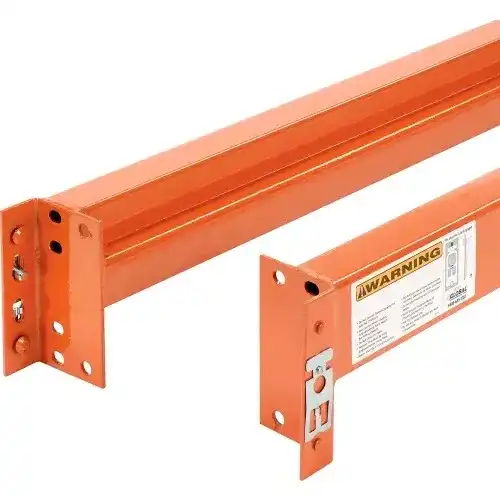
- Rolled beams: made from rolled steel, which is rolled to shape. Lighter weight and more economical, but lower load capacity. Available in a variety of heights (e.g., 3-inch, 4-inch, 6-inch) and gauges (the thicker, the stronger). For light to medium loads.
- Structural Beam: Welded from cut C-channel or tubing. Significantly higher load capacity with thicker gauge steel. Essential for heavy pallets or long spans.
- Step Beam: A roll-formed beam with steps to support the platform without clips. Load carrying capacity is similar to standard roll formed beams.
- Box Beam: A roll-formed beam with a fully enclosed cross-section for greater strength and rigidity, with a load capacity between a standard roll-formed beam and a structural beam.
8. Key points for safe shelf maintenance
Regular maintenance is essential to ensure that shelving retains its original load-bearing capacity and structural integrity:
- Regular Inspections: Conduct thorough visual inspections at least quarterly (monthly for high traffic areas) and after any impact.
- Column Protection: Install robust column guards at the end of aisles and at high risk impact points to prevent forklift trucks from damaging critical columns.
- Anchorage Integrity: Ensure that all frames are properly anchored to the ground according to manufacturer’s specifications and local codes. Check anchor bolts regularly.
- Loading Discipline: Strictly adhere to loading limits and distribute weight evenly. Train all warehouse employees in these principles.
9. Racking professionals
Given the complexity and high risk associated with pallet racking capacity, it is often wisest to seek expert guidance:
- Shelving Engineer: A licensed professional engineer (PE) specializing in storage systems can evaluate your existing setup, recalculate capacity after modification or damage, design new layouts, and provide stamped drawings to ensure compliance.
- Certified inspectors: Trained professionals, such as RMI-certified storage system inspectors, provide objective, comprehensive inspections that identify hidden risks in addition to basic visual inspections.
- Reputable Vendors/Integrators: By partnering with a reputable Aceally rack manufacturer or integrator, we provide detailed LARC drawings, proper installation by trained personnel, and ongoing support.
In conclusion
Pallet racking capacity is not a static number on a chart, but a dynamic foundation for warehouse safety and efficiency.
With an in-depth understanding of maximum racking capacity, the importance of compliance, OSHA regulations, influencing factors, and configuration differences, you’ll be able to improve the efficiency of your operation.
Choosing the right beams, performing rigorous maintenance, and utilizing specialized knowledge are essential steps.
Focusing on this knowledge can transform your racking from simple storage to a reliable, optimized, and safe asset that protects your employees, products, and ultimately your bottom line.
Make Load Capacity Awareness the Heart of Your Warehouse