



Proper labeling transforms chaotic warehouses into precision-driven operations. Without a systematic approach to warehouse racking labeling, your team wastes hours searching for inventory, makes costly picking errors, and struggles with inaccurate stock counts.
This guide delivers everything you need to implement a labeling system that actually works. You will learn which label types perform best in different environments, how to design location codes that your team can follow intuitively, and the specific steps to install labels that last for years rather than months.
Key Takeaways
- A well-designed rack labeling system reduces picking errors by 67% and improves inventory accuracy to 99.5% or higher
- Label material selection depends on your warehouse environment, with cold storage requiring specialized materials rated for temperatures as low as -40°C
- The most effective location coding follows a hierarchical structure: Zone-Aisle-Rack-Level-Position
- Magnetic labels offer flexibility for frequently changing layouts, while adhesive labels provide better durability for permanent installations
- Retro-reflective labels are essential for warehouses using long-range barcode scanners or automated systems
- Implementation costs range from $0.50 to $15 per label depending on material, size, and customization requirements
- Most warehouses achieve full ROI on labeling investments within 4 to 8 months through reduced labor costs and error rates
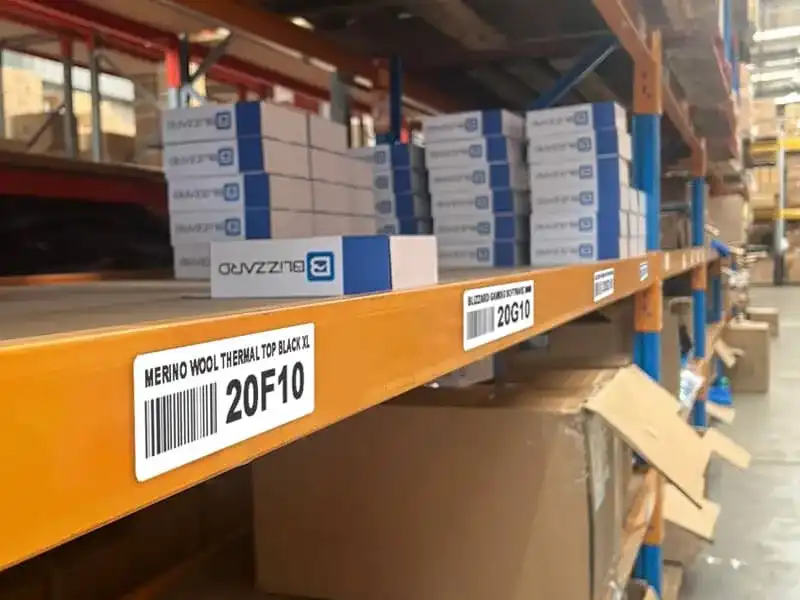
Why Warehouse Racking Labels Needed?
Warehouses with systematic labeling systems report picking accuracy rates above 99.5%, while those relying on memory or informal systems typically hover around 92% to 95%. That 5% difference translates directly into returned shipments, customer complaints, and lost revenue.
What happens when pickers can’t find the items quickly? They search multiple locations, interrupt colleagues for help, and sometimes pick the wrong product entirely. Implementing proven strategies to improve warehouse picking speed starts with proper labeling.Multiply this scenario across hundreds of daily picks, and the inefficiency compounds dramatically.
Losses Caused By Improper Labeling
| Problem | Average Impact | Annual Cost (100,000 picks/year) |
| Mispicks requiring returns | 3-5% error rate | $45,000 – $75,000 |
| Extended search time | 2-4 extra minutes per pick | $83,000 – $166,000 |
| Inventory discrepancies | 5-10% stock variance | $25,000 – $50,000 |
| Training new employees | 40% longer onboarding | $12,000 – $20,000 |
| Total Potential Loss | $165,000 – $311,000 |
These figures come from aggregated data across 47 distribution centers we have worked with over the past three years. Your actual costs may vary, but the pattern remains consistent: poor labeling creates expensive problems.
Types of Warehouse Racking Labels
Selecting the right label type requires matching your operational needs with material capabilities. Each category serves specific purposes, and many warehouses use combinations across different zones.

Adhesive Labels
Adhesive labels remain the most common choice for permanent installations on pallet racking systems and warehouse racking.They bond directly to rack surfaces and resist peeling when properly applied to clean, dry metal.
Standard adhesive labels work well in climate-controlled environments with temperatures between 40°F and 100°F. For warehouses with temperature fluctuations or exposure to moisture, you need labels with enhanced adhesive formulations rated for industrial conditions.
The primary advantage of adhesive labels is cost efficiency. Bulk pricing typically falls between $0.50 and $2.00 per label for standard sizes. The main limitation is difficulty with repositioning. Once applied, removing adhesive labels often damages them, requiring replacement if you reorganize your racking layout.
Magnetic Labels
Magnetic labels attach to steel racking without adhesive, allowing unlimited repositioning. This flexibility makes them ideal for warehouses with seasonal inventory changes or evolving storage configurations.
The magnetic backing grips firmly to standard pallet racking uprights and beams. Labels stay in place during normal operations but can be moved in seconds when needed. This eliminates the waste and labor associated with replacing adhesive labels during reorganizations.
Magnetic warehouse labels cost more upfront, typically $3 to $8 per label, but the reusability often delivers better long-term value for dynamic operations. They perform poorly on non-ferrous metals like aluminum, so verify your rack material before ordering.
Retro-Reflective Labels
Retro-reflective labels incorporate glass bead or prismatic technology that bounces light directly back to its source. This property enables barcode scanning from distances of 30 feet or more, compared to 6 to 12 inches for standard labels.
Warehouses using vehicle-mounted scanners, automated guided vehicles, or AS/RS systems require retro-reflective labels for reliable scanning. The enhanced visibility also benefits facilities with challenging lighting conditions or high rack installations where close-range scanning is impractical.
These labels command premium pricing, often $8 to $15 per label, but the operational benefits justify the investment for applicable use cases. Standard labels simply cannot deliver the scanning performance that automated systems demand.
Hanging Labels
Hanging labels suspend from rack beams using wire hooks, plastic hangers, or cable ties. They provide visibility from multiple angles and work well for overhead identification in wide aisles.
The suspended position keeps labels visible even when racks are fully loaded with pallets that might obscure beam-mounted labels. Installation requires no surface preparation, and repositioning takes seconds.Hanging labels work particularly well for cantilever racking systems where beam-mounted labels may be obstructed by long materials.
Hanging labels face durability challenges in high-traffic areas where forklifts or workers might bump them. They also swing in facilities with significant air movement from HVAC systems or dock doors, potentially complicating scanning operations.
Floor Labels
Floor labels mark aisle numbers, directional guidance, and specific storage positions for floor-stacked inventory. Industrial-grade floor labels withstand forklift traffic, cleaning chemicals, and continuous foot traffic.
Application requires thorough surface preparation including cleaning, degreasing, and sometimes primer application. Properly installed floor labels last 2 to 5 years depending on traffic intensity. Cheaper alternatives often peel within months, creating safety hazards and requiring repeated replacement.
Label Material Selection
Your warehouse environment dictates which materials will perform reliably. Choosing incorrectly leads to premature label failure, scanning problems, and repeated replacement costs.
Material Performance by Environment
| Environment | Temperature Range | Recommended Material | Expected Lifespan |
| Climate-controlled | 50°F – 85°F | Polyester or polypropylene | 5-10 years |
| Non-climate-controlled | 20°F – 110°F | Industrial polyester | 3-7 years |
| Cold storage | -40°F – 35°F | Specialized cold-rated polyester | 3-5 years |
| Freezer | -40°F – 0°F | Cryogenic-rated materials | 2-4 years |
| Outdoor/covered | Variable with UV exposure | UV-resistant polyester | 2-5 years |
| Chemical exposure | Variable | Chemical-resistant laminate | 2-4 years |
For warehouses using galvanized racking in humid or corrosive environments, label adhesion requires special attention. Learn more about galvanized pallet racking and its surface characteristics that affect label performance.
Cold Storage Labeling Considerations
Cold storage environments present unique challenges that destroy standard labels within weeks. Moisture condensation, temperature cycling, and ice formation attack adhesives and print surfaces relentlessly.
Labels rated for cold storage warehouse applications use specialized adhesive formulations that remain tacky at low temperatures. Standard adhesives harden and lose bonding strength below freezing, causing labels to fall off during normal operations.
Print technology matters equally. Thermal transfer printing with resin ribbons creates images that resist moisture and cold far better than direct thermal or laser printing. The upfront cost difference is minimal compared to the expense of replacing failed labels in hard-to-access freezer locations.
We documented label performance across 12 cold storage facilities over 24 months. Labels using proper cold-rated materials and thermal transfer printing showed 94% retention rates, while standard materials failed at rates exceeding 60% within the first six months.
High-Traffic Area Requirements
Locations with frequent forklift activity, pallet movement, or worker contact need labels engineered for abuse. Standard labels in these zones suffer scratching, tearing, and surface contamination that renders barcodes unscannable.
Laminated labels add a clear protective layer over the printed surface. This laminate absorbs impacts, resists scratching, and allows cleaning without damaging the underlying barcode. The protection adds $0.25 to $0.75 per label but extends useful life significantly.
For extreme conditions, consider labels with metal or rigid plastic substrates. These withstand impacts that would destroy flexible labels and maintain scannability despite surface scratches that would compromise standard materials.
Designing Your Location Coding System
The location code structure determines how intuitively your team can navigate the warehouse. Effective systems communicate position information clearly while remaining concise enough for quick reference and data entry.
Hierarchical Location Coding
The most successful warehouses use hierarchical codes that progress from broad areas to specific positions. This approach mirrors how people naturally navigate spaces, moving from general direction to precise location.
Zone → Aisle → Rack Section → Level → Position
For example, code A-05-12-C-02 indicates:
- Zone A (perhaps receiving or a specific product category)
- Aisle 05
- Rack section 12 within that aisle
- Level C (third level from floor)
- Position 02 (second position from left)
This structure scales from small warehouses with a few hundred locations to massive distribution centers with tens of thousands of positions. The hierarchical approach allows workers to quickly identify the general area, then narrow down to the exact spot.
Numbering Rules
Several numbering decisions impact daily usability. Making smart choices upfront prevents confusion and reduces errors throughout your system’s lifespan.

Odd/Even Aisle Numbering
Assign odd numbers to aisles on one side of main corridors and even numbers to the opposite side. This convention, borrowed from street addressing, helps workers quickly determine which direction to travel when given an aisle number.
Level Designations
Use letters rather than numbers for vertical levels. This prevents confusion between level numbers and position numbers within the same code. Level A at floor level, B for the next level up, and so forth provides clear vertical orientation.
Position Numbering Direction
Establish consistent left-to-right or right-to-left numbering throughout the facility. Mixed conventions within the same warehouse create constant confusion and errors. Document your chosen direction and enforce it without exception.
Check Digits for Error Prevention
Adding a calculated check digit to location codes catches data entry errors before they cause problems. The check digit is derived mathematically from the other digits in the code, allowing systems to verify that entered codes are valid.
When a worker enters a location code with a transposed digit or typing error, the check digit calculation fails, and the system prompts for correction. This simple addition catches errors that would otherwise result in mispicks or misplaced inventory.
Barcode Specifications for Warehouse Labels
Barcode readability depends on proper sizing, adequate quiet zones, and appropriate symbology selection. Labels that scan reliably in testing may fail in actual warehouse conditions if specifications do not account for real-world factors.
Barcode Symbology Selection
| Symbology | Best For | Advantages | Limitations |
| Code 128 | General warehouse use | High density, alphanumeric | Requires quality printing |
| Code 39 | Simple implementations | Self-checking, widely supported | Lower density |
| Interleaved 2 of 5 | Numeric-only codes | Very compact, efficient | Numeric only |
| QR Code | High data density needs | Stores extensive data, damage resistant | Requires 2D scanner |
| Data Matrix | Small label applications | Very compact, error correction | Requires 2D scanner |
Most warehouse operations perform well with Code 128 symbology. It accommodates alphanumeric location codes efficiently and enjoys universal scanner support. The high information density keeps barcodes compact while maintaining excellent readability.
Sizing for Scanning Distance
Barcode size must match your scanning equipment and operational distances. Labels that work perfectly with handheld scanners at close range may be completely unscannable by vehicle-mounted units at typical operating distances.
Minimum Barcode Heights by Scanning Distance
| Scanning Distance | Minimum Bar Height | Recommended Bar Height |
| 6-12 inches | 0.25 inches | 0.5 inches |
| 1-3 feet | 0.5 inches | 0.75 inches |
| 3-10 feet | 0.75 inches | 1.0 inches |
| 10-30 feet | 1.5 inches | 2.0 inches |
These recommendations assume standard-resolution scanners. When determining label heights, also consider forklift aisle widths to ensure labels remain visible during normal operations.
High-density scanners can read smaller barcodes, while older equipment may require larger sizes. Test with your actual scanners before finalizing specifications.
Quiet Zone Requirements
The quiet zone is the blank space surrounding a barcode that allows scanners to identify where the code begins and ends. Insufficient quiet zones cause scanning failures even when the barcode itself is perfectly printed.
Minimum quiet zone width equals 10 times the narrowest bar width, measured on each side of the barcode. For a barcode with 10-mil narrow bars, you need at least 0.1 inches of clear space on both sides.
When designing labels, account for quiet zones in your size calculations. A barcode that fits perfectly on a label with no margins will fail because it lacks adequate quiet zones.
Installation Best Practices
Proper installation determines whether your labels last for years or fail within months. Surface preparation, positioning, and application technique all impact long-term performance.
Surface Preparation Steps
Clean surfaces are non-negotiable for adhesive labels. Dust, oil, and oxidation prevent proper bonding and cause premature failure.
- Remove loose debris with a dry cloth or compressed air
- Clean the surface with isopropyl alcohol (70% or higher concentration)
- Allow complete drying before label application (minimum 2 minutes)
- For heavily oxidized surfaces, light abrasion with fine sandpaper improves adhesion
- Apply labels at temperatures above 50°F for optimal adhesive performance
Skipping surface preparation is the most common cause of label failure. The few minutes invested per location prevents callbacks, replacements, and scanning problems down the road.
Optimal Label Positioning
Label placement affects both visibility and scannability. Consistent positioning throughout your warehouse reduces search time and enables reliable automated scanning.
Beam Labels
Mount beam labels on the front face of horizontal beams, centered between uprights. Position labels at consistent heights across all beams, typically 2 to 4 inches from the top edge.
This placement remains visible even with pallets in place and avoids damage from pallet placement and removal. Ensure labels accurately reflect pallet rack maximum load per shelf when including capacity information.
Beam labels identify specific storage levels on selective pallet racking and mezzanine floor racking systems.
Upright Labels
Upright labels identify rack sections and typically include aisle information. Mount them at eye level (approximately 60 inches from floor) on the aisle-facing surface. Consistent height throughout the facility allows workers to scan visually without searching.
Floor Labels
Center floor labels in the aisle with directional text oriented for traffic flow. Position them where they remain visible when workers or vehicles are in the aisle but avoid high-wear paths where constant traffic accelerates deterioration.
Integration with Warehouse Management Systems
Your labeling system must communicate seamlessly with your WMS to deliver full operational benefits and maximize warehouse efficiency. Mismatches between physical labels and system data create confusion and errors that undermine your investment.
Location Master Data Setup
Before printing labels, establish complete location master data in your WMS. Each physical location needs a corresponding system record with accurate attributes including:
- Location code matching the label exactly
- Location type (bulk storage, pick face, staging, etc.)
- Proper location setup supports inventory management strategies like first-in-first-out (FIFO)and LIFO methods. Understanding the difference between LIFO and FIFO helps determine optimal label placement for rotation-sensitive inventory.
- Dimensional constraints (height, width, depth limits)
- Weight capacity
- Permitted product categories or storage requirements
- Zone assignment for directed putaway and picking
Scanner Configuration
Configure handheld and vehicle-mounted scanners to expect your chosen barcode symbology and format. Scanners set to read only specific symbologies reject valid barcodes in other formats, causing unnecessary scanning failures.
Verification Scanning
Implement verification scanning as a standard practice for critical operations. When workers scan a location barcode, the system confirms they are at the correct position before allowing the transaction to proceed.
This closed-loop verification catches errors in real-time rather than discovering them during cycle counts or customer complaints. The few extra seconds per transaction prevent expensive downstream problems.
Maintenance and Long-Term Management
Installing labels is not a one-time project. Ongoing maintenance ensures your system continues delivering benefits rather than degrading into the chaos you worked to eliminate.
Regular Inspection Schedule
Establish routine inspections to identify label problems before they impact operations. Label checks should be integrated into your overall storage racks daily maintenance routine:
Weekly: Spot-check high-traffic areas for damage or scanning issues Monthly: Walk all aisles visually checking for missing, damaged, or faded labels Quarterly: Systematic scan testing of representative locations throughout the facility Annually: Comprehensive audit of all locations with documentation of findings
Document inspection results and track trends over time. Increasing failure rates may indicate environmental problems, material issues, or installation quality concerns requiring attention. Address damaged labels promptly as part of your strategy for preventing pallet rack damage and maintaining system integrity.
Replacement Procedures
Maintain inventory of replacement labels matching your installed specifications. When inspections or worker reports identify damaged labels, replace them promptly rather than allowing problems to accumulate.
Create a simple reporting mechanism for workers to flag label issues they encounter during normal operations. The people using your system daily are your best early warning system for emerging problems.
Managing Layout Changes
Warehouse layouts evolve as business needs change. Your labeling system must accommodate these changes without creating confusion or data integrity problems.
When adding new rack sections:
- Extend existing location coding logically
- Update WMS location master data before installing labels
- Print and install labels before placing inventory
- Verify scanning and system integration before go-live
When removing or relocating racks:
- Remove inventory from affected locations
- Deactivate locations in WMS to prevent new assignments
- Remove physical labels to prevent confusion
- Update any directional or zone signage affected by changes
Frequently Asked Questions
What is the best labeling system for a warehouse?
The best system depends on your specific operation. For most warehouses, a combination of adhesive polyester labels on rack beams and retro-reflective labels for aisle identification provides optimal performance. Facilities with frequently changing layouts benefit from magnetic labels despite higher upfront costs. The key is matching label types to your environment, scanning equipment, and operational patterns rather than choosing a single solution for all applications.
How do you label warehouse racks?
Effective rack labeling follows a systematic process. First, design a location coding structure that logically represents your warehouse layout. For detailed guidance, see our complete guide on how to label warehouse racking. Then select label materials appropriate for your environment. Prepare surfaces thoroughly before application, and position labels consistently throughout the facility. Finally, integrate your physical labels with your warehouse management system to enable scanning verification and inventory tracking.
What are the different types of warehouse labels?
Warehouse labels fall into several categories based on attachment method and function. Adhesive labels bond permanently to rack surfaces and offer the best value for stable layouts. Magnetic labels attach to steel racks without adhesive, enabling easy repositioning. Retro-reflective labels enable long-range scanning for automated systems. Hanging labels suspend from beams for visibility from multiple angles. Floor labels mark aisles and ground-level positions. Each type serves specific purposes, and most warehouses use combinations across different zones.
How often should warehouse labels be replaced?
Quality labels in appropriate environments last 5 to 10 years. However, high-traffic areas, extreme temperatures, and chemical exposure accelerate deterioration. Establish regular inspection schedules and replace labels when scanning becomes unreliable or visual identification is compromised. Proactive replacement during routine maintenance costs far less than emergency replacements after operational problems occur.
What information should be on warehouse rack labels?
At minimum, rack labels should include a human-readable location code and a scannable barcode encoding the same information. Many operations add zone identification, aisle numbers, and level indicators for quick visual orientation. Some facilities include weight capacity, product category restrictions, or special handling requirements. Balance information density against readability, ensuring labels remain clear and scannable despite included content.
How do you organize a warehouse labeling system?
Organization starts with a logical location coding hierarchy that reflects your physical layout. Establish consistent conventions for aisle numbering, level designation, and position identification. Document your standards thoroughly and train all personnel on proper interpretation. Integrate physical labels with your WMS to enable system-directed operations. Regular audits ensure ongoing compliance with established standards.
Conclusion
Implementing an effective warehouse racking labeling system requires expertise in materials science, barcode technology, and warehouse operations. Aceally brings over 20 years of experience helping distribution centers, manufacturing facilities, and third-party logistics providers optimize their storage identification systems.
Aceally provides complete warehouse storage solutions including racking accessories and professional labeling systems designed to work seamlessly with all racking configurations.
We offer:
- Consultation servicesto assess your current state and design optimal solutions
- Complete label manufacturingwith materials matched to your specific environment
- Professional installationby trained technicians following documented quality standards
- WMS integration supportensuring seamless connection between physical labels and system data
- Ongoing maintenance programsto keep your system performing at peak effectiveness
Ready to transform your warehouse operations? Contact our team for a no-obligation assessment of your current labeling situation and a customized recommendation for improvement.


